
What is Buck-Boost Converter : Advantages and Disadvantages
Advertisement
A buck-boost converter is a DC-DC power converter capable of increasing or decreasing input voltage to maintain a desired output level. It is widely used in battery-powered devices, renewable energy systems, and power management circuits. Advantages include voltage flexibility, while disadvantages include circuit complexity and potential switching noise.
Features & Working of Buck Boost Converter
A buck boost converter is a type of DC-to-DC converter whose output voltage can be either greater or less than the magnitude of the input voltage. There are two main topologies viz. inverting and non-inverting.
- Inverting: The output voltage polarity is opposite to the input polarity.
- Non-Inverting: The output voltage polarity is the same as the input polarity.
These converters are often used as switching regulators. They employ a switching element (typically one or two MOSFETs) and an energy storage device (like an inductor) to efficiently regulate the input voltage to a lower or higher output voltage.
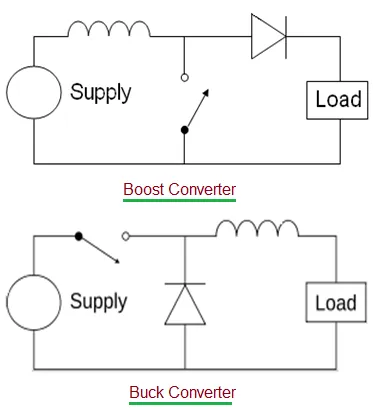
Image Credit: Wikipedia
- A buck converter is also known as a step-down converter. It reduces the voltage (while increasing the current) from its input (supply voltage) to its output load.
- A boost converter is also known as a step-up converter. It increases the voltage (while decreasing the current) from its input (supply voltage) to its output load.
Advantages of Buck-Boost Converters
Here are some of the benefits of using buck-boost converters:
- Efficient Solution with Small Components: Buck converters offer a highly efficient solution while requiring minimal external components.
- Step-Up or Step-Down: They can both step-up and step-down voltage using a minimal number of components, making them versatile.
- Lower Operating Duty Cycle: Buck-boost converters generally require a lower operating duty cycle.
- High Efficiency: They offer high efficiency across a wide range of input and output voltages.
- Cost-Effective: They are relatively inexpensive compared to many other types of converters.
Disadvantages of Buck-Boost Converters
Here are some of the drawbacks associated with buck-boost converters:
- Discontinuous Current: The input current and charging current of the output capacitor are discontinuous. This can lead to the need for larger filters and more EMI (Electromagnetic Interference) issues.
- Inverted Output: The output voltage is inverted (for inverting topologies), which complicates sensing and feedback circuit design. Since the sensed voltage is negative, an inverting op-amp is typically needed for feedback and closed-loop control.
- Limited High Gain: Achieving high gain can be challenging as the efficiency tends to decrease at very small or large duty cycles.
- No Isolation: There is no isolation between the input and output sides, which can be a critical requirement in certain applications.
- Control Complexity: The transfer function of the converter contains a right-half plane zero, which introduces control complexity and makes the converter more difficult to control.
Summary
Buck boost converters regulate voltage by stepping it up or down as needed. Advantages include flexible voltage control, while disadvantages include design complexity and switching losses.