
What is CFP: C Form Factor Pluggable
Advertisement
CFP (C Form-Factor Pluggable) is a high speed optical transceiver standard designed for data communication networks. It supports transmission rates ranging from 40 Gbps to 100 Gbps and beyond, enabling efficient connectivity in data centers, telecommunications infrastructure and high capacity optical networking applications. This page explains the fundamentals of CFP and outlines its different types.
Introduction
CFP stands for C Form Factor Pluggable. The “C” in CFP represents the number 100, alluding to 100 Gigabit Ethernet systems.
The CFP is governed by a multi-source agreement (MSA) to ensure a common form factor for the transmission of high-speed digital signals.
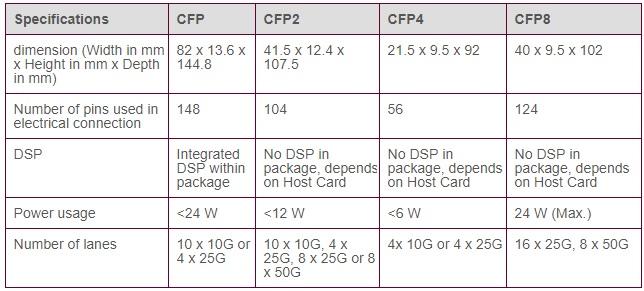
The CFP transceiver adheres to specifications agreed upon by various manufacturers. Different CFP types exist, including CFP, CFP2, CFP4, and CFP8.
The table below highlights the differences between these CFP variants:
Advertisement


