
Entropy: Basics and Markov Sources
By RF Wireless Expert Team
Advertisement
This page describes the basics of entropy and presents the entropy equation for Markov sources. It also clarifies the differences between bits, decits, and nats.
- The information content in a signal is high if its probability of occurrence is low.
- If the probability of occurrence of a message is p_, then its information content _I is defined as follows.
Difference between Bits vs Decit vs Nat
The following equations highlight the difference between Bits, Decits, and Nats:
I = log2(1/p)… BitsI = log10(1/p)… Decit or HartleyI = ln (1/p)… nat
Entropy Basics
- The average information content per symbol in a group of symbols is known as entropy and is represented by H.
- If there are M symbols, and their probabilities of occurrence are p1, p2, …, pi, …, pM_, then entropy _H is expressed as follows:
H = SUM(from i=1 to i=M) pi*log2(1/pi) bits/symbol
Entropy will be maximum when the probability of occurrence of all M symbols is equal. In this case, H max = log2(M) bits/symbol.
If a data source is emitting symbols at a rate rs (symbols/sec), then the source information rate R is given by:
R = rs * H (bits/sec)
Entropy of Markov Sources
The entropy of a Markov source is expressed as follows:
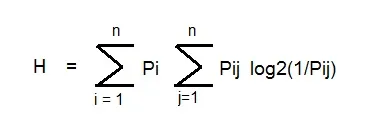
Where:
- pi is the probability that the source is in state i.
- Pij is the probability when it is going from state i to state j.
A Markov source is a source that emits symbols dependently.