
What is MIPI CSI Interface : Advantages and Disadvantages
Advertisement
MIPI CSI (Camera Serial Interface) is a high-speed interface standard used to connect image sensors and cameras to processors in smartphones, embedded systems, and automotive devices. Advantages include high data throughput and low power consumption, while disadvantages include design complexity and specialized hardware requirements.
What is MIPI CSI Interface?
The MIPI CSI (Camera Serial Interface) is a high-speed protocol designed for point-to-point image and video transmission between cameras and host devices like PCs, mobile phones, tablets, and laptops. It’s also finding use in automotive applications. MIPI defines protocol interface specifications between application processors and cameras, between processors and displays, and between baseband ICs and RF ICs.
The CSI interface specifications are published and managed by the MIPI (Mobile Industry Processor Interface) alliance. Various versions have been released, including CSI-V1.0, CSI-V2.0, and CSI-V3.0.
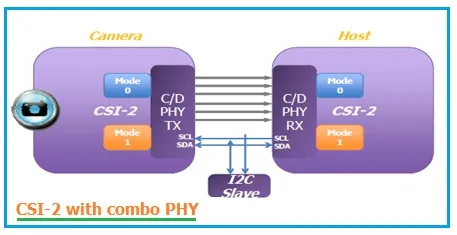
The figure below depicts the MIPI CSI 2.0 combo interface. CSI utilizes I2C as a control interface between the camera and the host processor.
-
MIPI CSI-1: This was the original MIPI interface for cameras, defining the architectural interface between a camera and a host processor.
-
MIPI CSI-2: This stands for Camera Serial Interface second generation. It’s the most common interface for mobile applications, connecting smartphone camera modules to an SoC (System on a Chip). SoCs typically provide up to 6 serial lanes, which can be used to connect one or more cameras. Each lane offers bandwidth up to 300 MB/sec, enabling high-resolution camera modules to operate at high speed.
-
MIPI CSI-3: This version uses 32 virtual channels and packet-based transmission, supporting in-band interrupts. It offers a signaling rate of up to 5.8 Gb/s per lane and is backward compatible with earlier MIPI CSI-2 interfaces.
Advantages of CSI Interface
Here are the benefits of the CSI interface:
- Widely Used: It’s extensively used in mobile devices.
- High Performance: Offers high performance capabilities.
- Low Power Consumption: Consumes minimal power.
- Lower Pin Count: Reduces EMI and PCB space/complexity issues due to a lower pin count.
- Simple Protocol: It has a very straightforward interface protocol.
- High Bandwidth: Provides high bandwidth to support increasing frame rates and resolutions.
- Reusable and Scalable: Supports a reusable and scalable protocol stack.
- Improved Reliability and Lower Cost: Offers improved reliability and lower overall system cost.
- Faster than USB 3.0: MIPI CSI-2 is faster than the USB 3.0 interface. It can handle video from 1080p to 8K and beyond due to its low overhead.
- Efficient CPU Usage: It uses fewer CPU resources due to multi-core processor support.
Disadvantages of CSI Interface
The following are the drawbacks of the CSI interface:
- Limited Cable Length: MIPI CSI-2 supports a cable length of less than 30 cm, which is shorter compared to USB 2.0 (< 5 meters) and USB 3.0 (< 5 meters).
- No Plug and Play: Plug-and-play functionality is not supported in MIPI CSI-2, unlike the USB interface.
- Medium to High Manufacturing Cost: The cost of manufacturing is medium to high, while USB manufacturing cost is lower compared to CSI.
- Driver Dependency: It’s essential to have a driver for the targeted camera/SoC. Otherwise, extra development efforts are required to develop the driver and software protocol stack, which can be time-consuming and expensive.
Summary
MIPI CSI enables efficient camera-to-processor communication in modern electronic devices. Advantages include high-speed image transfer, while disadvantages include implementation complexity and hardware dependency.