
Crystal vs Oscillator: Difference Between Crystal and Oscillator
Advertisement
Crystal and oscillator are two closely related components used to generate stable timing and frequency references in electronic and RF systems. A quartz crystal acts as a highly accurate resonator, while an oscillator combines the crystal with an electronic circuit to produce a continuous clock signal.
What is Crystal?
This component is known as quartz crystal resonator. It is a piezoelectric material and packaged in small metallic or ceramic casing. When we apply a voltage to it, it physically deforms. When we remove the voltage, it snaps back, generating a tiny electrical charge.
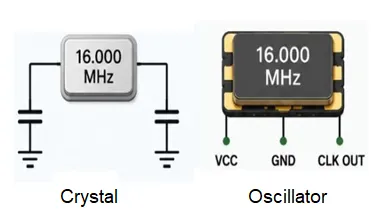
By placing it in a specific electrical circuit, it will physically vibrate (i.e. resonate) at a highly specific, stable frequency such as the 16.000 MHz example in our diagram.
Key characteristics of crystal
- A crystal does not generate a clock signal on its own. It is a passive piece of vibrating rock.
- To produce a usable clock signal, the crystal must be connected to an active oscillator circuit. In recent microcontroller unit, this circuit is usually built-in directly.
- A bare crystal typically requires two external “load capacitors” connected to ground to stabilize the oscillation and ensure it starts up correctly.
- It is available at very low cost.
What is Oscillator?
It is available in larger package in which both quartz crystal and active circuitry are housed together to form active crystal oscillator module.
Key characteristics of oscillator
- It is active and generates clock signal by itself.
- It does not rely on internal circuitry of MCU nor it requires external load capacitors.
- The main pins are VCC, GND and CLK OUT. As soon as it has power on VCC pin and GND is connected, it outputs a clean square wave on its Clock Out (CLK OUT) pin.
- Oscillators are more expensive than bare crystals.
- It consumes slightly more power compared to bare crystal.
Difference between Crystal and Oscillator
| Parameter | Crystal (Resonator) | oscillator (Active module) |
|---|---|---|
| Component Type | Passive | Active |
| Generates Clock Alone? | No. Requires external driving circuit. | Yes. It is a self contained clock generator. |
| MCU Dependence | Relies on the MCU’s internal oscillator circuit. | Independent. Can provide a clock to any device. |
| Typical pin count | 2 pins (sometimes 4 for physical stability). | 4 pins (VCC, GND, Output, Enable/Disable). |
| External Components Required | Yes. Usually requires two load capacitors. | No. Plug and play. |
| Cost | Lower | Higher |
Summary
A crystal provides precise resonance, whereas an oscillator generates the usable clock signal. Selecting the appropriate device depends on frequency accuracy, stability, power consumption, and application requirements.
Continue Learning Oscillator Fundamentals & Types
- Oscillator Types
- Voltage Controlled Oscillators (VCOs)
- NE 566 VCO and its application in PLL Design
- Numerically Controlled Oscillator (NCO) and its use in DDS Design
- Understanding YIG Oscillators
- Backward Wave Oscillators (BWO): Advantages & Disadvantages
- OCXO SC Cut Crystal Oscillator: Advantages & Disadvantages
- Understanding Oven-Controlled Crystal Oscillators (OCXO)