
Backward Wave Oscillator (BWO) vs. Traveling Wave Tube (TWT)
Advertisement
This page highlights the key differences between a Backward Wave Oscillator (BWO), also known as a Carcinotron, and a Traveling Wave Tube (TWT). Links to comparisons such as TWT vs. Klystron are also provided.
Backward Wave Oscillator (BWO) or Carcinotron
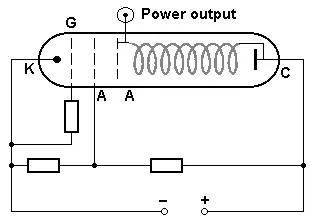
BWOs, or Carcinotrons, are a type of TWT oscillator where the electron beam interacts with an electromagnetic (EM) wave supported by its structure. The figure above (derived from Wikimedia Commons) illustrates this.
The key difference between a BWO and a TWT is the direction of propagation:
-
BWO: In a Backward Wave Oscillator, the electron beam and the electromagnetic wave travel in opposite directions.
-
RF power is extracted at the output port located near the electron gun.
The main advantages of a BWO are its wide electronic tuning range and its relative insensitivity to load variations. These features have driven the development of this type of microwave tube as a valuable source for millimeter-wave applications.
BWOs are powerful and reliable wave generators, supporting radio frequencies up to 130 GHz.
Traveling Wave Tube (TWT)
As the name suggests, a TWT, or Traveling Wave Tube, is a structure primarily used as a microwave RF power amplifier. It’s commonly used for high-power amplification.
Continue Learning Microwave Tubes: Klystrons, TWTs, Magnetrons, BWOs, CFAs
- Microwave Tube Classification
- Klystron and Gunn Diode Microwave Test Benches
- Traveling Wave Tube: Advantages & Disadvantages
- Magnetron: Advantages & Disadvantages
- Klystron : Advantages & Disadvantages
- BWO (Backward Wave Oscillators): Advantages & Disadvantages
- Crossed-Field Amplifier: Advantages & Disadvantages
Explore Comparison between Microwave Tubes
- TWT vs Klystron : Key Comparison
- Klystron vs Magnetron: Understanding the Differences
- Gyrotron vs Magnetron vs Orbitron vs Peniotron vs Ubitron
- Magnetron vs Crossed-Field Amplifier