
What is TRAPATT Diode: Advantages and Disadvantages
Advertisement
A TRAPATT (Trapped Plasma Avalanche Triggered Transit) diode is a microwave semiconductor device that generates high power RF and microwave signals through avalanche multiplication. Its advantages include high conversion efficiency and significant microwave power output, while its disadvantages include higher noise levels, limited frequency stability, and complex operating requirements compared to other microwave diodes.
TRAPATT Diode : Structure and Characteristic waveforms
In short, a TRAPATT (TRApped Plasma Avalanche Triggered Transit) diode is a microwave energy source used as both an amplifier and an oscillator. It’s a type of semiconductor diode that operates efficiently below frequencies of 10 GHz. One key characteristic is that it requires a greater voltage swing for its operation.
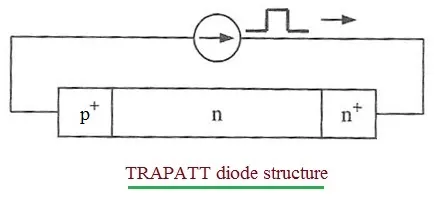
Figure 1: TRAPATT diode structure
The structure of a TRAPATT diode, as shown in Figure 1, typically consists of a p+ - n - n+ (or n+ - p - p+) configuration. The n-type depletion region has a width ranging from 2.5 to 12.5 µm, while the diode diameter spans from 50 to 750 µm. These diodes are commonly manufactured using silicon, and the p+ region is kept very thin, usually between 2.5 and 7.5 µm.
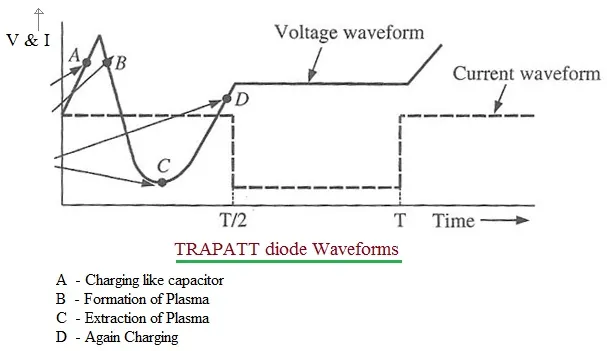
Figure 2: TRAPATT diode waveforms
Figure 2 illustrates TRAPATT diode waveforms, showing its operation at various points. You might also be interested in a comparison of BARITT, IMPATT, and TRAPATT diodes.
Applications of TRAPATT Diodes
TRAPATT diodes find use in a variety of applications, including:
- Microwave beacons
- Local oscillators in Radar systems
- ILS (Instrument Landing System)
- S-Band pulsed transmitters for phased array radar
- Radio altimeters
Benefits or Advantages of TRAPATT Diodes
- Higher Efficiency: They offer significantly higher efficiency compared to IMPATT diodes, achieving efficiencies of around 15 to 40%.
- Low Power Dissipation: TRAPATT diodes dissipate very little power.
- Suitable for Pulsed Operation: They are particularly well-suited for pulsed operation scenarios.
- Wide Frequency Range: They can operate across a frequency range of approximately 3 to 50 GHz.
Drawbacks or Disadvantages of TRAPATT Diodes
- Not Ideal for Continuous Operation: They are not typically used for continuous operation due to high power densities, ranging from 10 to 102 W/m2.
- High Noise Figure: TRAPATT diodes exhibit a very high noise figure, around 60 dB.
- Frequency Limitations: They are typically limited to frequencies below the millimeter wave band.
Summary
TRAPATT diodes are specialized microwave devices used in radar transmitters, microwave generators, and RF power systems where high efficiency signal generation is required. Their power generation advantages make them suitable for specific high-power applications, although frequency stability, noise characteristics, and design complexity limit broader commercial use.