
Traveling Wave Tube (TWT) Gain Calculator & Formula
Advertisement
The Traveling Wave Tube (TWT) is a high frequency vacuum electronic amplifier widely used in microwave and millimeter wave systems due to its broad bandwidth and high power capability. The amplification mechanism in a TWT is based on the continuous interaction between an electron beam and a slow wave structure, typically a helix, which synchronizes the phase velocity of the RF signal with the electron beam velocity. This page provides a Traveling Wave Tube (TWT) gain calculator and formula.
Example:
INPUTS:
- RF Frequency (f) = 3 GHz
- Helix Impedance (K) = 50 Ohm
- Applied DC voltage (V) = 3 KV
- DC Current (I) = 20 mA
- Electron Velocity (Vo) = 3.25E7 m/sec
- Length (L) = 0.3 meters
OUTPUTS:
- C, Pierce Gain Parameter = 0.043
- k, Pierce Propagation Constant = 579.98
- N (Electronic Length) = 27.69
- TWT Gain simplified model (Neper) = 15.2
- TWT Small Signal Gain (dB) = 132.06
- TWT Gain Ideal Three Wave Theory (dB) = 47.69
TWT Gain Formula
The following equation or formula is used for the Traveling Wave Tube (TWT) calculator.
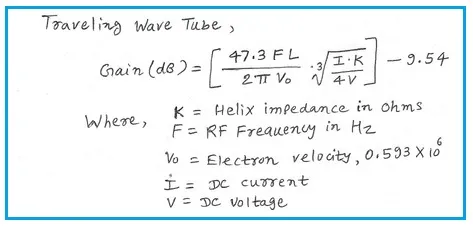
- The formula mentioned above is ideal three wave theory based.
- The other formula is Pierce exponential based.
Above calculator provides outputs based on both of these formulas. The RF frequency and electron velocity control synchronism, a critical condition for sustained energy transfer. Helix impedance directly influences coupling efficiency, with higher impedance generally leading to increased gain. The applied DC voltage sets the electron beam velocity and kinetic energy, while the DC current determines the available beam power contributing to amplification. Finally, the interaction length governs the cumulative growth of the RF signal, with longer tubes providing higher gain up to stability and saturation limits.
Summary: The TWT gain formula quantitatively describes how efficiently RF power is amplified through beam wave interaction along the helix structure.
References
- Book on Microwave Devices and Circuits (3rd Edition), Author: Samuel Y. Liao
Continue Learning Microwave Tubes: Klystrons, TWTs, Magnetrons, BWOs, CFAs
- Microwave Tube Classification
- Klystron and Gunn Diode Microwave Test Benches
- Traveling Wave Tube: Advantages & Disadvantages
- Magnetron: Advantages & Disadvantages
- Klystron : Advantages & Disadvantages
- BWO (Backward Wave Oscillators): Advantages & Disadvantages
- Crossed-Field Amplifier: Advantages & Disadvantages
Explore Comparison between Microwave Tubes
- TWT vs Klystron : Key Comparison
- Klystron vs Magnetron: Understanding the Differences
- Gyrotron vs Magnetron vs Orbitron vs Peniotron vs Ubitron
- Backward Wave Oscillator (BWO) vs Traveling Wave Tube (TWT)
- Magnetron vs Crossed-Field Amplifier