
Automatic Gain Control (AGC) Basics
Advertisement
This page describes the basics of the Automatic Gain Control (AGC) algorithm. AGC monitors the received signal and automatically controls the gain in a receiver. It’s especially useful in handsets or mobile devices.
As the signal transmitted from a base station reaches a mobile device, it travels through different paths and terrains, leading to variations in the received signal strength. The movement of wireless mobile devices at varying speeds also contributes to these signal strength fluctuations. In this situation of time-varying signals, it becomes necessary to control the level or gain of the signal before it’s passed to the baseband processing chain for data decoding.
The intelligence built into the mobile device to monitor and control the gain automatically is called Automatic Gain Control (AGC). AGC is a crucial module in the signal processing chain of the receiver.
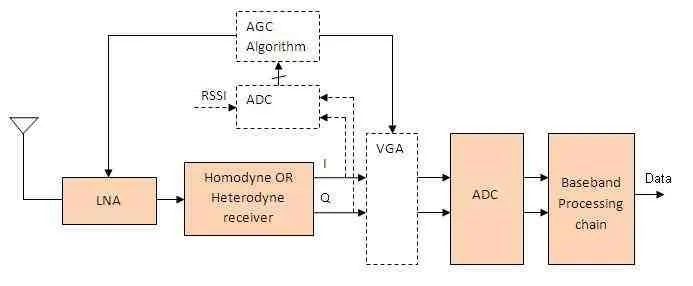
As shown in the figure, a normal receiver will have specific modules (shaded in the diagram). To implement Automatic Gain Control, a VGA (Variable Gain Amplifier) is inserted, and the AGC algorithm is implemented on either an FPGA or DSP. The LNA also needs to be changed to a variable gain type if it isn’t already present on the circuit. Since the AGC algorithm works on digital data, an additional ADC is also included.
The Automatic Gain Control Algorithm continuously monitors RSSI and/or the received I and Q baseband signals and determines how much gain change is required in the LNA and VGA modules. RSSI stands for Received Signal Strength Indication, which is a voltage equivalent to the received instantaneous input power. This is calculated using an RF power detector (an additional module) or by calculating I² + Q² of the received baseband signal vector.
Variable gain LNAs and VGAs typically have either an analog attenuator or a digital attenuator, which can be controlled by an analog voltage or a digital word. The gains are adjusted by applying attenuations in this manner.
Estimation and Correction Algorithms
- Automatic Time Offset Estimation and Correction
- Automatic Frequency Correction Algorithm
- Channel Estimation and Equalization in MATLAB for OFDM Packet
- Frequency Offset Estimation in MATLAB for OFDM Packet
- IQ Imbalance and Compensation
Continue Learning Fading & Channel Characteristics
- Fading Basics and Types in Wireless Communication
- Fast Fading vs Slow Fading
- Flat Fading vs Frequency Selective Fading
- Small-Scale Fading vs Large-Scale Fading
- Rician vs Rayleigh Fading Channels
Continue Learning Interference & Mitigation Techniques
- Understanding Interference and its Types
- ISI vs co-channel vs adjacent channel RF interference : Key differences
- Self-Interference Cancellation (SIC) in 5G
- Femtocell Interference: Causes, Effects, and Mitigation
- SAIC (Single Antenna Interference Cancellation) in GSM