
AM-AM Conversion in Power Amplifiers
Advertisement
This article describes AM-AM conversion basics in Power Amplifiers (PAs), its causes, and its effects on the constellation points of modulated signals. AM-AM conversion is essentially a measure of the AM-AM distortion (which is nonlinear) present in a power amplifier (PA).
This distortion arises due to unwanted amplitude changes, often caused by temperature fluctuations, power supply variations, and multipath fading encountered by the RF signal. This type of distortion is more noticeable in amplitude-modulated signals such as QAM, AM, etc.
As illustrated in Figure 1, the ideal input signal X(t) should ideally behave as described in Equation 1. However, due to nonlinear distortion, the output signal will instead be represented by Equation 2. Here, the term g[A(t)] is what contributes to the AM-AM conversion.
AM-AM conversion occurs due to amplitude variations at the input of the amplifier device.
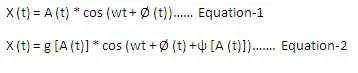 Fig.1 AM-AM/AM-PM conversion Equation
The unit of AM-AM conversion is dB/dB.
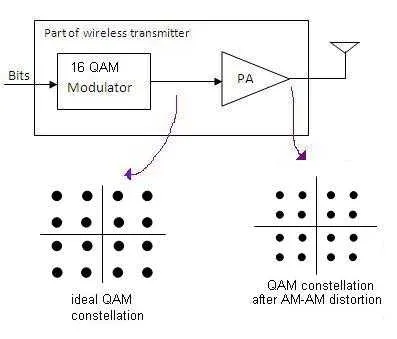
QPSK constellation changes as shown in the fig. 2 due to AM-AM-conversion, but due to other impairments in the system such as AM-PM distortion, I-Q mismatch, phase noise etc. one cannot distinct whether the effect (constellation change) is due to which of the impairments.
Continue Learning Power Amplifiers (PA) & RF Amplifiers
- RF Amplifier Basics & Power Amplifier Design
- Class A vs Class B Amplifier
- Class G vs Class H Amplifiers
- SCPA vs MCPA Power Amplifiers
Explore Specialized Architectures in Amplifiers
- Doherty Amplifier: Advantages & Disadvantages
- Crossed-Field Amplifier: Advantages & Disadvantages
- Parametric Amplifier Basics
- Programmable Gain Amplifier Basics
- Memory Polynomials vs AI in 6G Power Amplifier
- GaN on SiC Amplifier
- GaN RF Power Amplifier Manufacturers
Continue Learning Distortion & Nonlinearities (AM-AM, AM-PM)
- Understanding Distortion in RF Amplifiers
- Passive Intermodulation Distortion (PIM): Causes & Mitigation
- IQ Imbalance and Compensation