
What is Analog Beamforming : Advantages and Disadvantages
Advertisement
Analog beamforming is a signal processing technique that steers antenna radiation patterns using analog phase shifters and RF circuitry. It improves signal strength and coverage in wireless communication systems. Advantages include lower power consumption and cost, while disadvantages include limited flexibility and reduced multi user support.
Introduction: The purpose of beamforming is to improve coverage by using an antenna array to control the amplitude and phase of signals. There are three main types of beamforming based on different architectures:
- Analog beamforming
- Digital beamforming
- Hybrid beamforming
What is Analog Beamforming?
In analog beamforming, the amplitude and phase variation is applied to the analog signal at the transmitter end. At the receiver, signals from different antennas are combined before Analog-to-Digital Conversion (ADC). It’s well-suited for frequency-flat beamforming applications.
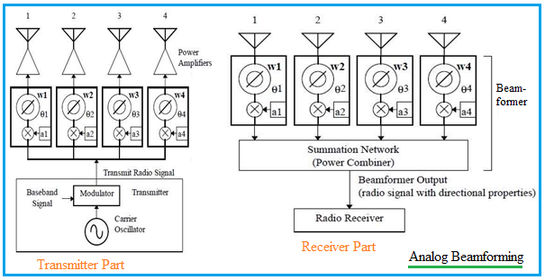
Figure 1: Analog Beamforming Block Diagram
Wk = ak _ ejsin(θk) Wk = ak _ cos(θk) + j * ak sin(θk)
Where:
- Wk represents the complex weight for the kth antenna in the array.
- ak is the relative amplitude of the weight.
- θk is the phase shift of the weight.
Weights are applied to analog signals in analog beamforming.
Benefits or Advantages of Analog Beamforming
The following are the benefits or advantages of analog beamforming:
- Simple hardware implementation.
- Hardware can fit within the lattice at high frequencies (all silicon array only).
- Benefits from the full array gain.
- Offers the lowest system DC power.
- Best for coverage due to low power consumption and cost characteristics.
Drawbacks or Disadvantages of Analog Beamforming
The following are the drawbacks or disadvantages of analog beamforming:
- Only one data stream feeds the antenna elements. This limits the data rate and flexibility of the architecture.
- Not ideal for capacity and flexibility requirements, unlike digital beamforming.
- Cannot be used in frequency-selective beamforming applications, unlike digital beamforming.
- The number of beams are fixed in hardware.
Summary
Analog beamforming improves wireless coverage through directional signal transmission. Advantages include lower cost and power consumption, while disadvantages include limited adaptability and scalability.
Advertisement


