
What is Shared Aperture Antenna: Advantages and Disadvantages
Advertisement
A shared aperture antenna is a multi-band antenna system that allows multiple antennas or frequency bands to operate through a common physical aperture. Its advantages include reduced size, lower weight, and efficient space utilization, while its disadvantages include complex design, mutual coupling effects, and challenging isolation requirements between antenna elements.
Shared Aperture Antenna Structure
The shared aperture antenna falls under the category of phased array antennas.
This antenna type essentially combines the functionalities of multiple antennas into a single aperture. Different sub-arrays, mounted on the same aperture, are utilized for various applications, often on a time or frequency-shared basis.
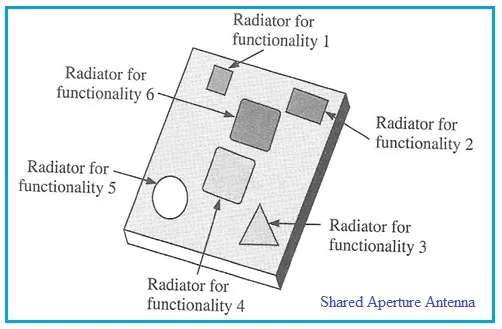
Space and weight are critical considerations in military aircraft, ships, and land vehicles. To address these concerns, shared aperture antennas have emerged, combining several antenna functionalities into a single antenna to meet reduced space and weight demands.
Benefits or Advantages of Shared Aperture Antenna
- Cost Reduction: A shared aperture antenna houses the functionalities of multiple individual antennas, such as reflector antennas and phased arrays, on a single aperture, leading to significant cost savings.
- Reduced Radar Cross-Section (RCS): It helps in reducing the RCS of military aircraft, making them less detectable.
- Weight and Volume Reduction: It reduces the overall weight and volume of the aircraft system. This is because the need to mount numerous individual antennas externally on the aircraft skin is eliminated.
Drawbacks or Disadvantages of Shared Aperture Antenna
- Design Complexity: The design is complex, requiring careful testing to ensure simultaneous operation of multiple antenna functionalities without interference.
Summary
Shared aperture antennas enable compact, high performance communication and radar systems by integrating multiple antenna functions into a single aperture. Their integration advantages improve platform efficiency and reduce hardware requirements, although electromagnetic interference, design complexity, and optimization challenges must be carefully addressed.
Continue Learning About Antenna Technology
- Antenna Basics Tutorial
- Antenna Related Terms
- Antenna mechanical Vs. electrical tilt
- Difference between antenna gain directivity efficiency
- Antenna gain & effective area
- Bandwidth Vs. beamwidth antenna difference
- Antenna Factor
- Near field Vs. Far field antenna radiation pattern
Explore Different Types of Antennas
-
Check-out: Guide to List of Antenna Types >>