
Analog vs. Digital Modulation: Key Differences Explained
Advertisement
This article breaks down the differences between analog and digital modulation techniques, explaining the fundamentals and providing clear examples. Before diving into the specifics, let’s cover the basics of modulation.
Modulation is essential for transmitting analog or digital signals wirelessly or through wired media. It involves using an input signal (the information to be transmitted), a carrier signal (usually a high-frequency signal), and producing a modulated output signal. The input signal, whether analog or digital, is often referred to as the modulating waveform or signal.
Analog Modulation
Analog modulation involves modulating analog signals. Figure 1 illustrates this with Amplitude Modulation (AM) as an example. Both the input signal and the carrier signal are analog. The amplitude, frequency, or phase of the carrier signal is varied in accordance with the input signal.
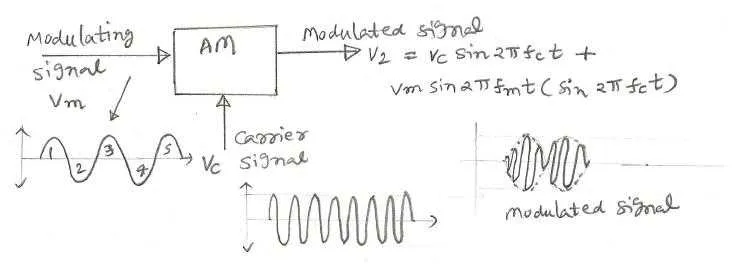 Fig.1 Analog Modulation (AM example)
Examples of Analog Modulation:
- AM (Amplitude Modulation): The amplitude of the carrier signal varies according to the amplitude of the analog input signal.
- FM (Frequency Modulation): The frequency of the carrier signal varies according to the frequency of the analog input signal.
- PM (Phase Modulation): The phase of the carrier signal varies according to the phase of the analog input signal.
Digital Modulation
Digital modulation, on the other hand, deals with modulating digital signals. Figure 2 demonstrates this with Amplitude Shift Keying (ASK) as an example. The input signal is digital, while the carrier signal is analog. Based on the digital signal input (logic 1 or logic 0), the carrier frequency is manipulated before transmission.
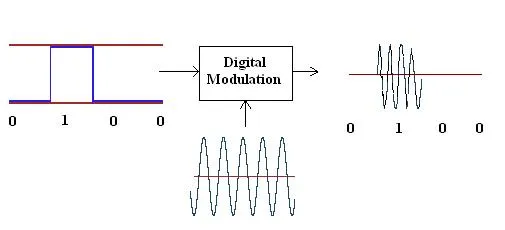 Fig.2 Digital Modulation (ASK example)
Examples of Digital Modulation:
- ASK (Amplitude Shift Keying): The carrier signal (constant amplitude and frequency) is present when a binary 1 digital signal is transmitted, and absent during binary 0 transmission.
- FSK (Frequency Shift Keying): Different carrier frequencies are transmitted for binary 1 and binary 0 periods.
- PSK (Phase Shift Keying): The carrier signal with different phases is transmitted for binary 1 and binary 0 periods.
Other digital modulation techniques include BPSK, QPSK, QAM, 8PSK, etc.
Continue Learning Modulation Types
- AM Vs. FM Vs. PM : Difference between Analog Modulation Techniques
- ASK Vs. FSK Vs. PSK : Difference between Digital Modulation Techniques
- PAM Vs. PWM Vs. PPM : Difference between Pulse Modulation Techniques
- BPSK Vs. QPSK : Key Differences
- 16-QAM Vs. 64-QAM Vs. 256-QAM : Key Differences
- 512-QAM Vs. 1024-QAM Vs. 2048-QAM Vs. 4096-QAM
- 4096QAM Modulation Used in Wi-Fi 7
- MSK Vs. GMSK : Modulation Technique used in GSM
- LORa Modulation Used in LoRaWAN
- 10% ASK & 100% ASK Modulation used in NFC
- OOK Vs. VPPM Vs. CSK : Visible Light Communication (VLC) Modulation Techniques
- QPSK Vs. OQPSK Vs. PI/4 QPSK
- PAM4 Modulation Used in Gigabit Ethernet
- CCK Vs. DSSS Vs. OFDM Used in WLAN (Wi-Fi) Standards