
QAM Calculator : 16, 64, 256, 512, 1024, 4096 Modulation
Advertisement
QAM, or Quadrature Amplitude Modulation, is a method of encoding data onto a radio frequency carrier wave by varying both the amplitude and phase of the signal. This allows for the transmission of more data within a given bandwidth compared to simpler modulation techniques. There are several variations of QAM, including 16-QAM, 64-QAM, 256-QAM, 512-QAM, 1024-QAM and 4096-QAM.
QAM calculator example:
- INPUTS:
- Symbol rate in symbol/s = 1000000
- Modulation type = 64-QAM
- OUTPUT:
- Bitrate = 6 Mbps
- Spectral efficiency = 6 bits/s/Hz
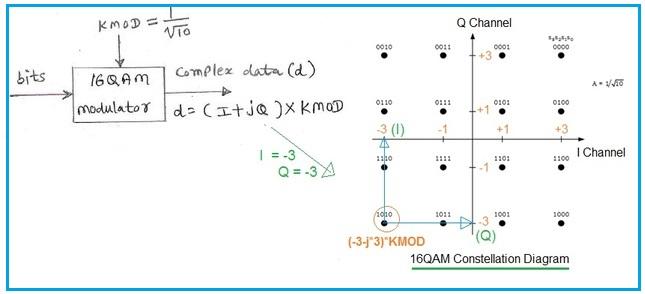
16-QAM Modulation
- Bits per symbol: 4
- 16-QAM encodes 4 bits of information per symbol.
- It is more resistant to noise and interference, making it suitable for environments where signal quality might be compromised. However, this robustness comes at the cost of a lower data rate when compared to 64-QAM and 256-QAM. The constellation diagram for 16-QAM shows 16 distinct points, each representing a unique 4-bit combination.
64-QAM Modulation
- Bits per symbol: 6
- 64-QAM encodes 6 bits per symbol.
- Offers good balance between data rate and resistance to errors. It’s a popular choice for applications like digital video broadcasting (DVB) and is found in some older cable systems.
256-QAM Modulation
- Bits per symbol: 8
- 256-QAM encodes 8 bits per symbol
- Offers increased data throughput. It is used for high bandwidth applications. Digital cable television systems commonly employ 256-QAM to deliver more channels and higher quality video.
512-QAM Modulation
- Bits per symbol: 9
- 512-QAM encodes 9 bits per symbol.
- Provides even higher data rates than 256-QAM, but is more susceptible to noise and interference. It is used in some advanced wireless communication systems where high data rates are required.
1024-QAM Modulation
- Bits per symbol: 10
- 1024-QAM encodes 10 bits per symbol.
- Offers very high data rates, but is even more sensitive to noise and interference than 512-QAM. It is used in cutting-edge wireless communication systems and research applications.
4096-QAM Modulation
- Bits per symbol: 12
- 4096-QAM encodes 12 bits per symbol.
- Provides extremely high data rates, but is highly susceptible to noise and interference. It is used in experimental and research settings where maximizing data throughput is a priority and signal quality can be maintained.
Comparison Table
The following table summarizes key specifications for 16-QAM, 64-QAM, and 256-QAM.
| Specifications | 16-QAM modulation | 64-QAM modulation | 256-QAM modulation | 512-QAM modulation | 1024-QAM modulation | 4096-QAM modulation |
|---|---|---|---|---|---|---|
| Number of bits per symbol | 4 | 6 | 8 | 9 | 10 | 12 |
| Symbol rate | (1/4) of bit rate | (1/6) of bit rate | (1/8) of bit rate | (1/9) of bit rate | (1/10) of bit rate | (1/12) of bit rate |
| KMOD | 1/SQRT(10) | 1/SQRT(42) | 1/SQRT(170) | 1/SQRT(340) | 1/SQRT(680) | 1/SQRT(1360) |
| Spectral efficiency | 4 bits/s/Hz | 6 bits/s/Hz | 8 bits/s/Hz | 9 bits/s/Hz | 10 bits/s/Hz | 12 bits/s/Hz |
Conclusion
As the QAM order increases, spectral efficiency and data rates improve, but the system becomes more susceptible to interference, noise, and signal distortion. These modulation schemes are widely used in wireless communication technologies such as Wi-Fi, LTE, 5G, 6G cable modems and digital broadcasting.
Advertisement


