
SC-FDMA vs. OFDMA: Key Differences Explained
Advertisement
This article compares SC-FDMA and OFDMA modulation techniques, highlighting their differences. We’ll use the example of QPSK data symbols being transmitted, as shown in Figure 1, to illustrate the comparison.
In LTE uplink, a Resource Block (RB) consists of 12 contiguous subcarriers.
For simplicity, Figure 1 only represents 4 subcarriers across two symbols to demonstrate the differences between the two techniques.
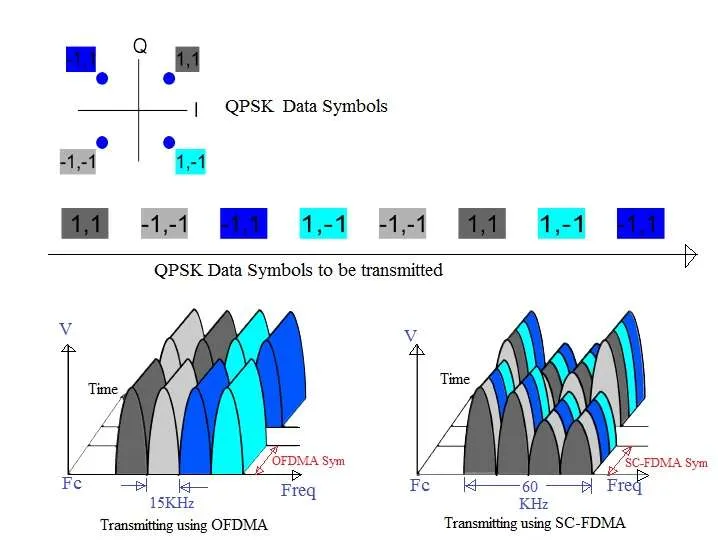 SC-FDMA vs OFDMA
Let’s summarize the key differences between SC-FDMA and OFDMA based on Figure 1:
- Parallel vs. Serial Transmission: OFDMA transmits 4 QPSK symbols in parallel, with one data symbol per subcarrier. SC-FDMA, on the other hand, transmits QPSK symbols serially but at 4 times the rate compared to OFDMA. Consequently, a QPSK symbol in SC-FDMA occupies a much wider bandwidth, approximately M x 15kHz, where M is the number of subcarriers.
- Multi-Carrier vs. Single-Carrier: OFDMA is a multi-carrier system where each subcarrier carries one data symbol. SC-FDMA is a single-carrier system where each QPSK symbol is carried by a single subcarrier with a much wider bandwidth.
- Symbol Length and Sub-Symbols: Although the symbol length remains the same (approximately 66.7µS) in both OFDMA and SC-FDMA, an SC-FDMA symbol contains multiple sub-symbols, representing QPSK data symbols.
- PAPR (Peak-to-Average Power Ratio): The parallel transmission of multiple data symbols in OFDMA leads to a higher PAPR. In SC-FDMA, the PAPR is the same as that of the original QPSK data symbols because M QPSK data symbols are transmitted serially at M times the rate compared to OFDMA.
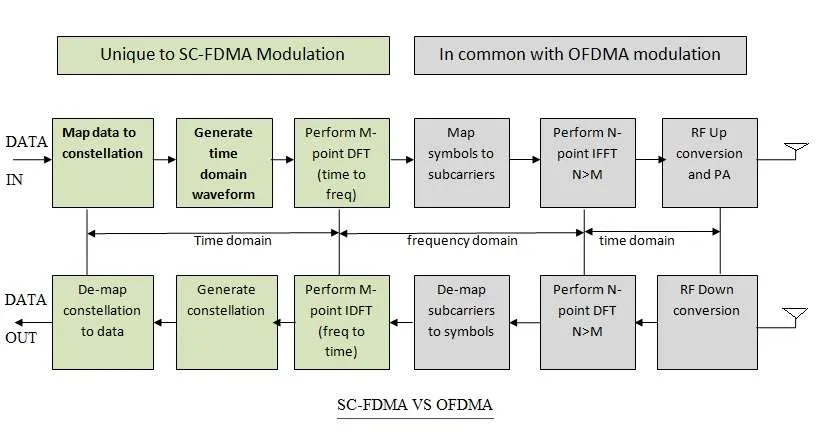 difference between SC-FDMA and OFDMA
Figure 2 illustrates the block diagrams of SC-FDMA and OFDMA systems. The figure highlights the modules unique to SC-FDMA and those common to both systems. As mentioned, the DFT before the IFFT in OFDMA and the IDFT after the DFT in the SC-FDMA system differentiate the two.
Continue Learning OFDM/OFDMA & Related Techniques
- OFDM Basics & its Benefits & Limitations
- OFDM Variants : COFDM, OFDMA, f-OFDM, VOFDM, WOFDM, Flash OFDM
- OFDMA in Wireless Communication
- OFDMA : Key Advantages & Disadvantages
Implementation of OFDM & OFDMA in Physical Layer
- OFDM Implementation in Fixed WiMAX Physical Layer
- OFDMA Implementation in Mobile WiMAX Physical Layer
- Measurements in OFDM Physical Layer
- What is MU-OFDMA in Wi-Fi 6 (IEEE 802.11ax)
Advanced OFDM Techniques used in Wireless Systems
- CP-OFDM vs DFT-S-OFDM: Waveform Differences in 5G
- NOMA vs OFDMA: Key Differences in 5G Wireless
- OFDM vs. f-OFDM (Filtered-OFDM) : Key Differences
- OFDM vs FBMC (Filter Bank Multi-Carrier): key Comparison
- OFDM vs OTFS (Orthogonal Time Frequency Space) : Key Differences
- Hybrid OFDM - OFCDM Modulation Explained