
MU-MIMO vs. OFDMA: Key Differences Explained
Advertisement
This article breaks down the key distinctions between MU-MIMO (Multi-User Multiple Input Multiple Output) and OFDMA (Orthogonal Frequency Division Multiple Access).
MU-MIMO and OFDMA are techniques used to improve the performance of wireless communication systems. Let’s dive into what makes them different.
MU-MIMO Explained
MU-MIMO stands for Multi-User Multiple Input Multiple Output.
-
How it Works: In MU-MIMO, multiple data streams are transmitted simultaneously, as illustrated in Figure 1. Beamforming techniques are used to target individual users, effectively increasing overall capacity.
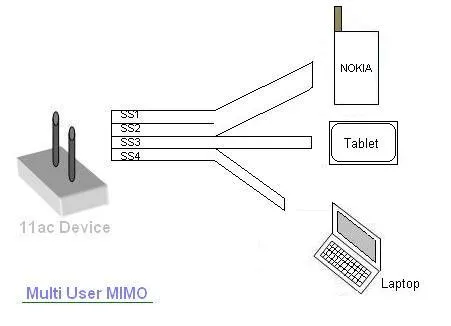
Image alt: Multi user MIMO
-
Advantages:
- Increases overall capacity.
- Results in higher speeds for individual users.
- Ideal for applications requiring high bandwidth.
-
Applications:
- Used in both uplink and downlink of 802.11ax (Wi-Fi 6).
- Used in the downlink of 802.11ac (Wi-Fi 5).
OFDMA Explained
OFDMA stands for Orthogonal Frequency Division Multiple Access.
-
How it Works: OFDMA allocates subcarriers to users based on their specific bandwidth needs. It doesn’t necessarily increase capacity, but it uses the available resources more efficiently.
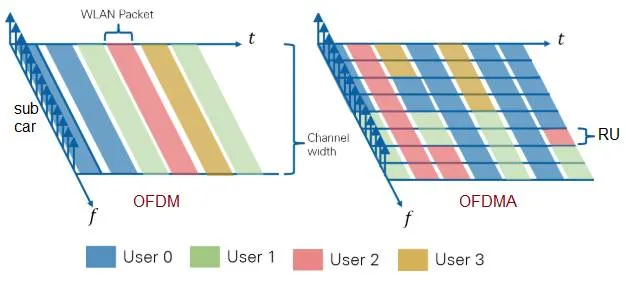
Image alt: OFDM vs OFDMA
-
OFDM vs. OFDMA:
- In OFDM (Orthogonal Frequency Division Multiplexing), all subcarriers of a symbol are dedicated to a single user at a time. This can lead to wasted resources if the user doesn’t have data to transmit during that time.
- In OFDMA, multiple users can be multiplexed simultaneously, each with its dedicated set of subcarriers. This allows scheduling multiple users with varying bandwidth requirements. Figure 2 (above) illustrates the difference in frame structures between OFDM and OFDMA.
- In OFDMA, a Resource Unit (RU), consisting of a subchannel and a number of symbols, is allocated to individual users.
-
Advantages:
- Increases efficiency in resource utilization.
- Reduces latency.
- Ideal for low bandwidth applications.
-
Applications:
- Used in cellular wireless technologies like WiMAX (16e), LTE, and 5G.
- Also used in 802.11ax (Wi-Fi 6).
Conclusion
Both MU-MIMO and OFDMA are valuable techniques that complement each other to improve wireless network performance.
Advanced OFDM Techniques used in Wireless Systems
- CP-OFDM vs DFT-S-OFDM: Waveform Differences in 5G
- NOMA vs OFDMA: Key Differences in 5G Wireless
- OFDM vs. f-OFDM (Filtered-OFDM) : Key Differences
- OFDM vs FBMC (Filter Bank Multi-Carrier): key Comparison
- OFDM vs OTFS (Orthogonal Time Frequency Space) : Key Differences
- Hybrid OFDM - OFCDM Modulation Explained
Explore & Compare OFDM/OFDMA Variants
- FDM Vs. OFDM : Key Differences
- Single Carrier Vs. OFDM : Key Comparison
- OFDM Vs. OFDMA : Difference between them
- MU-OFDMA Vs. MU-MIMO used in Wi-Fi 6 (IEEE 802.11ax)
Explore OFDMA Source-Codes in Python & MATLAB
Continue Learning MIMO Basics & Types
- MIMO Vs. SISO and Advantages and Disadvantages of MIMO
- STBC vs SM (Spatial Multiplexing) MIMO Techniques
- Difference Between D-MIMO (Distributed) and Coordinated Multi-AP
- SU-MIMO vs MU-MIMO Differences
- Massive MIMO: Advantages and Disadvantages
- Advantages and Disadvantages of UM-MIMO in 6G
- 8T8R vs 64T64R Massive MIMO Antennas