
MU-OFDMA vs MU-MIMO: Key Differences Explained
Advertisement
This article compares MU-OFDMA and MU-MIMO, highlighting their key differences in the context of WLAN 802.11ax.
Introduction:
MU-MIMO (Multi-User Multiple-Input Multiple-Output) enhances overall network capacity by enabling simultaneous transmission of multiple data streams. In contrast, MU-OFDMA (Multi-User Orthogonal Frequency Division Multiple Access) improves efficiency by allocating subcarriers to users based on their individual needs. It’s important to note that MU-OFDMA doesn’t inherently increase capacity like MU-MIMO does. These two technologies are designed to work together, complementing each other in modern Wi-Fi networks.
MU-OFDMA in 802.11ax
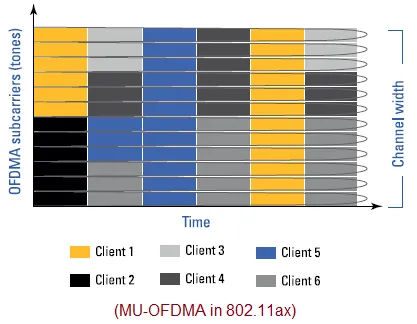
Image Courtesy: Aerohive Networks
- OFDMA is essentially a multi-user version of OFDM (Orthogonal Frequency Division Multiplexing), which is used in 802.11a/g/n/ac.
- It enables multiple client devices (users), each with varying bandwidth requirements, to utilize the Wi-Fi network concurrently.
- OFDMA divides the Wi-Fi channel into smaller frequency allocations known as Resource Units (RUs).
- The Access Point (AP) can communicate simultaneously with individually assigned clients due to their unique RU allocations.
- In MU-OFDMA, the channel bandwidth is divided into multiple smaller channels. Each of these channels can be used by multiple clients at different points in time, which is a departure from previous Wi-Fi standards.
MU-MIMO in 802.11ax
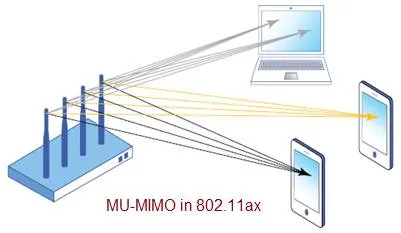
Image Courtesy: Aerohive Networks
- MU-MIMO uses different spatial streams to facilitate communication between multiple client devices.
- It employs beamforming techniques to establish unique connections with specific clients.
- The minimum RU size required to use MU-MIMO in 802.11ax is 106 subcarriers or higher.
- The IEEE 802.11ax standard leverages both MU-MIMO and MU-OFDMA to improve network performance. OFDMA provides multi-user access by splitting a single channel into multiple subcarriers, while MU-MIMO offers multi-user access by utilizing different spatial streams.
- MU-MIMO is best suited for scenarios with low client density and applications requiring high bandwidth, where large packets are used for transmission.
Difference between MU-OFDMA and MU-MIMO
The following table summarizes the key differences between MU-OFDMA and MU-MIMO:
| Features | MU-OFDMA | MU-MIMO |
|---|---|---|
| Full form | Multi User Orthogonal Frequency Division Multiple Access | Multi User Multiple Input Multiple Output |
| Function | Offers multi-user access by division of channel. | Offers multi-user access by using different spatial streams. |
| Efficiency/capacity | Increased efficiency | Increased capacity |
| Latency/Data rate | Reduced latency | Higher data rates per user |
| Applications | Ideal for low bandwidth applications | Ideal for high bandwidth applications |
| Packet size | Best with small size packets | Best with large size packets |
Continue Learning MIMO Basics & Types
- MIMO Vs. SISO and Advantages and Disadvantages of MIMO
- STBC vs SM (Spatial Multiplexing) MIMO Techniques
- Difference Between D-MIMO (Distributed) and Coordinated Multi-AP
- SU-MIMO vs MU-MIMO Differences
- Massive MIMO: Advantages and Disadvantages
- Advantages and Disadvantages of UM-MIMO in 6G
- 8T8R vs 64T64R Massive MIMO Antennas
Advanced OFDM Techniques used in Wireless Systems
- CP-OFDM vs DFT-S-OFDM: Waveform Differences in 5G
- NOMA vs OFDMA: Key Differences in 5G Wireless
- OFDM vs. f-OFDM (Filtered-OFDM) : Key Differences
- OFDM vs FBMC (Filter Bank Multi-Carrier): key Comparison
- OFDM vs OTFS (Orthogonal Time Frequency Space) : Key Differences
- Hybrid OFDM - OFCDM Modulation Explained
Explore & Compare OFDM/OFDMA Variants
- FDM Vs. OFDM : Key Differences
- Single Carrier Vs. OFDM : Key Comparison
- OFDM Vs. OFDMA : Difference between them
- MU-MIMO Vs. OFDMA : Key Differences