
What is a Patch Antenna? Basics, Design & Types Explained
Advertisement
A patch antenna is a low profile, planar antenna consisting of a conductive radiating patch placed over a dielectric substrate with a ground plane on the opposite side. Also known as a microstrip patch antenna, it is widely used in wireless communication, GPS, WLAN, Bluetooth, radar, satellite communication, and IoT devices because of its compact size, low cost, and ease of integration with printed circuit boards. This article explains patch antenna basics, its common types and applications.
Construction & Working
In its most fundamental form, a patch antenna is a “sandwich.” It consists of three main layers.
- The Patch: A flat, very thin piece of metal (usually copper or gold) on the top. It can be rectangular, square, circular, or more complex shapes.
- The Substrate: A non-conductive dielectric material (like Teflon or FR4 circuit board material) in the middle.
- The Ground Plane: A larger, continuous flat piece of metal on the bottom.
When an electrical signal is fed into the top metallic patch, it creates an electromagnetic field between the patch and the ground plane below it. Because the patch has edges, the electrical fields bulge or fringe out into the air at the ends of the patch. These fringing fields are what actually radiate the radio waves out into space.
Types of Patch Antennas
Following are the common types of patch antennas.
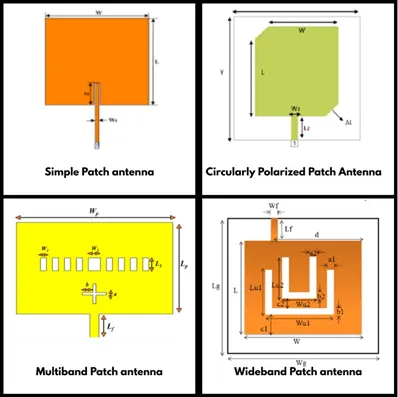
1. Simple Patch Antenna
-
This is the most basic form, typically rectangular. The dimensions of the patch, specifically the length (L), primarily dictate the frequency at which the antenna will resonate and operate. The width (W) affects the antenna’s impedance and radiation pattern.
-
The Feed Mechanism is cut-out notch called an inset feed. The electrical resistance (impedance) at the very edge of a patch is high, while the impedance of the feed line is usually lower (typically 50 ohms). Pushing the feed point inward allows engineers to match the impedance perfectly, ensuring maximum power transfers from the radio to the antenna without being reflected back.
2. Circularly Polarized Patch Antenna
-
A standard simple patch radiates a linearly polarized wave (the wave moves strictly up and down or side to side). This antenna modifies a nearly square patch to radiate a circularly polarized wave.
-
Circular polarization is highly desirable for GPS and satellite communications. Because the wave is spinning, the receiving antenna doesn’t need to be perfectly aligned vertically or horizontally with the transmitting antenna to pick up the signal.
3. Multiband Patch Antenna
-
Modern devices often need to connect to multiple networks simultaneously (e.g., a phone using 5G, Wi-Fi, and Bluetooth). Instead of using three separate antennas, engineers use one multiband antenna.
-
It has been extensively modified by cutting shapes out of the metal; specifically a row of rectangular slots () and a cross shaped slot (). Because different paths have different lengths, the single antenna can now resonate at multiple, distinct frequency bands simultaneously.
4. Wideband Patch Antenna
-
While a multiband antenna targets specific, separate frequencies, a wideband antenna is designed to operate continuously over a very large chunk of the frequency spectrum without losing performance.
-
The prominent feature here is the large “U-shaped slot” cut directly into the center of the patch. This specific geometry introduces a secondary resonance that occurs at a frequency very close to the main patch’s primary resonance. This geometry increases its bandwidth compared to the simple patch.
Advantages and disadvantages
Advantages: They possess a very low profile (flat), are lightweight, inexpensive to manufacture using standard printed circuit board (PCB) techniques, and easily conform to curved surfaces (like the skin of an aircraft).
Disadvantages: Historically, simple patch antennas suffer from narrow bandwidth (they only work well on a very specific frequency) and relatively low gain compared to large dish antennas.
Summary
A patch antenna, also known as a microstrip patch antenna, is a compact, low-profile antenna widely used in wireless communication, GPS, Wi-Fi, radar, satellite, and IoT applications. It consists of a conductive patch, dielectric substrate and ground plane, and offers easy PCB integration, low cost and simple fabrication. Different patch shapes and feeding techniques can be used to achieve the required frequency, bandwidth, gain and radiation characteristics.
Explore Different Types of Antennas
-
Check-out: Guide to List of Antenna Types >>