
TRF Radio Receiver Basics and Circuit Design
Advertisement
This application note covers the basics of Tuned Radio Frequency (TRF) receivers. It explains the TRF radio circuit and how it serves as an improvement over a basic crystal radio receiver.
As shown in the figure below, stages of amplification are added both before and after the demodulator. This significantly improves the sensitivity of the tuned radio frequency receiver.
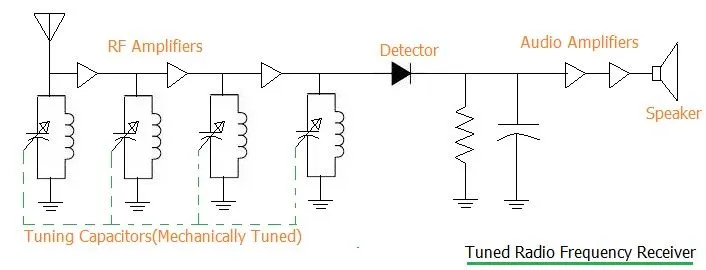 TRF radio receiver circuit
As illustrated in the figure, three stages of RF amplification are used between the antenna and the detector. This configuration substantially increases the amplitude of the received signal.
Furthermore, two audio amplifiers are employed after the detector. These amplifiers provide the necessary gain to operate a loudspeaker effectively.
A key advantage of the TRF design is improved selectivity. When multiple resonant LC circuits, all tuned to the same frequency, are cascaded, the overall selectivity is enhanced. The more stages included, the narrower the bandwidth becomes, and the steeper the skirts of the frequency response.
TRF receivers have been widely adopted in various applications.
Most TRF circuits incorporate a knob for tuning the capacitance, which in turn adjusts the resonant frequency. In earlier designs, each tuned capacitor in the cascaded stages had its own separate knob. However, later designs integrated a single knob to control all capacitances simultaneously, simplifying the tuning process.
Radio Antenna Tuner Vs TV Antenna Tuner
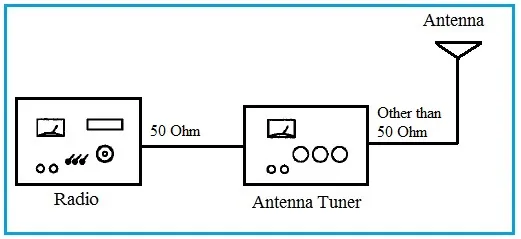 Radio Antenna Tuner
Continue Learning RF Technology
- What is RF Signal : Radio Frequency Fundamentals
- RF Related Terminologies
- RF Components & Their Basic Functions, Manufacturers
- What is RF Radiation: Safety, Uses & Health Concerns
Explore RF Test & Measurements Resources
- RF Measurements Basic Tutorial
- OFDM Physical Layer & RF Measurements
- RF LNA Test Procedure & its Measurements
- RF Wafer Probe Testing and On-Wafer Measurement
Explore More Radio Technologies & Standards
- DMR Radio Basics Tutorial
- TETRA Radio System Tutorial
- LITRA (LTE Integrated Trunked Radio) Explained
- OpenSky Radio System Basics
- Public Safety Radio Frequencies (USA)
- Two-Way Radio Headsets Basics
- Understanding CBRS (Citizens Broadband Radio Service)
- Commercial and Concept Radio Systems
- PMR446 Radio Frequency Channels
Explore Broadcasting, AM/FM & Ham Radio
- Regular FM Radio Broadcasting Basics
- HD Radio Technology & AM/FM Spectrum Explained
- Digital Radio Mondiale (DRM)
- IBOC Basics (In-Band On-Channel Digital Radio)
- Radio Broadcasting: Advantages & Disadvantages
- Analog vs Digital Radio
- Amateur Radio Bands and Frequencies
- Ham Radio: Advantages & Disadvantages
- Internet Radio: Advantages & Disadvantages