
What is 8B6T Line Coding : Advantages and Disadvantages
Advertisement
8B6T line coding is a transmission technique that converts 8-bit binary data into six ternary symbols to improve bandwidth efficiency. Advantages include reduced transmission bandwidth and efficient encoding, while disadvantages include higher implementation complexity and increased sensitivity to transmission errors. It is used in specific high speed networking applications.
8B6T Line Coding Procedure
8B6T is a multilevel line coding scheme used to encode “m” data elements into a pattern of “n” signal elements. Specifically, 8B6T converts 8 bits of data into 6 signal elements using three signal levels: positive (+), negative (-), and zero (0). This code finds its application in 100Base-4T cables.
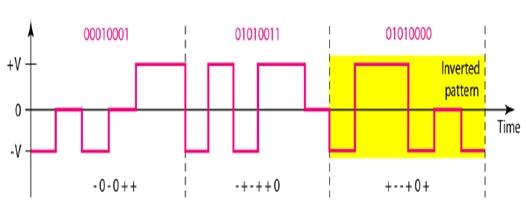
This line code utilizes 28 (256) different data patterns and 36 (729) different signal patterns. This leaves us with approximately 473 redundant signal elements.
The figure above illustrates the encoding of three different data patterns into corresponding signal patterns.
- First 8-bit pattern [00010001]: Encoded as signal pattern [- 0 - 0 + +] with a weight of 0.
- Second 8-bit pattern [01010011]: Encoded as [- + - + + 0] with a weight of +1.
- Third 8-bit pattern [01010000]: Encoded as [+ - - + 0 +] with a weight of +1.
To achieve DC balance, the sender inverts the last bit pattern using a weight of -1. For example:
- The third pattern becomes [- + + - 0 -] before transmission (shown in yellow).
- The receiver easily identifies this inverted pattern and inverts it again before decoding, restoring the pattern to its original form.
The average signal rate (Save) is calculated as (1/2) ** N ** (6/8), where N is the data rate. The minimum bandwidth is approximately 6N/8.
Advantages of 8B6T Line Coding
- Synchronization and Error Detection: The redundant data provided by 8B6T aids in synchronization and error detection during transmission.
- DC Balance: The redundancy enables DC balance through the use of inverted patterns at the transmitting end.
- Increased Baud Rate: 8B6T increases the number of bits per baud, effectively raising the speed or baud rate.
Disadvantages of 8B6T Line Coding
- Increased Bandwidth: The use of redundant data bits leads to an increase in bandwidth requirements.
- Complexity at the Receiver: The receiver needs to distinguish between three distinct levels (+, -, 0) to accurately decode the data bits.
- Complexity at the Sender: The sender needs to maintain a record of weight and possess the intelligence to determine the weight of groups. If two groups with a weight of “1” are encountered consecutively, the first group is transmitted as is, while the second group is completely inverted to provide a weight of “-1”.
Summary
8B6T line coding reduces bandwidth requirements by encoding binary data into ternary symbols. Advantages include spectral efficiency, while disadvantages include greater complexity and error sensitivity.
Advertisement


