
HFSWR Block Diagram: Detecting Stealth Aircraft
Advertisement
Introduction : Conventional radar systems often struggle to detect targets beyond the line of sight (LOS) horizon or stealth aircraft designed to evade high frequency microwave signals. High Frequency Surface Wave Radar (HFSWR) offers a robust alternative.
Operating in the HF band (typically 3–30 MHz), HFSWR leverages the conductive properties of seawater to propagate signals along the ocean surface. It enables detection of ships and low flying aircraft including stealthy targets which are far beyond the visible horizon. In this tutorial, we delve into the architecture and components of HFSWR radar and explain how it works to provide wide area maritime and aerial surveillance.
How HFSWR Detects Stealth Aircraft
As it operates at low frequencies, vertically polarized radio waves cling to the conductive salt water of the ocean. This allows radar signal to bend over the horizon, detecting ships and low flying missiles at ranges exceeding 200 nautial miles.
Stealth aircrafts such as F-35 are designed to defeat high frequency radars by its geometric shape (e.g. angled surfaces) and absorbing material based coating.
Following characteristics help HFSWR in defeating stealthing effect used by stealth aircrafts or missiles.
- Wavelength mismatch : HFSWR generates massive waves which are 10 to 100 meters long.
- Resonance effect : When radar waves are of roughly same size as the target, the entire aircraft resonates (i.e. vibrates electrically).
- Rayleigh scattering : This pushes reflection into “rayleigh or Mie resonance regions”. The aircraft acts like a dipole antenna, reflecting a strong signal back to the radar regardless of its stealth coating.
HFSWR Radar Architecture & its components
Transmit chain :
- Transmits a Frequency Modulated Continuous Wave (FMCW) or a coded pulse sequence designed to maximize average power on the target.
- It blasts energy over a wide sector (e.g., 120 degrees) of the ocean simultaneously.
Propagation channel : The salt water acts as a transmission line. The vertical electric field of the radar wave couples with the ocean surface. The signal loses significant energy as it drags along the water, which is why HFSWR requires high power during transmission and sensitive receiver.
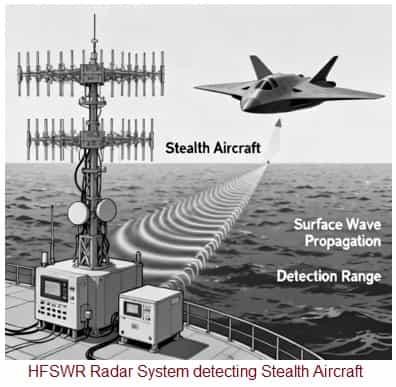
Receive chain : Linear Phased Array is used for receiver part.
Signal Processing Unit : The raw signal returning from the ocean is messy. It is full of noise from lightning, ionospheric interference, and massive reflections from ocean waves. The processor cleans this up.
Comparison between HFSWR Radar Vs. Standard Radar
| Feature | HFSWR Radar | Standard Radar |
|---|---|---|
| Operating Frequency | HF Band | Microwave Band |
| Range | Beyond Horizon (300 Km+) | Line of Sight Only |
| Stealth Detection | Excellent (Due to Resonance) | Poor (Deflected by Shaping) |
| Antenna Size | Long Arrays | Compact |
| Resolution | Low (Good for detection/bad for targeting) | High (Good for targeting/guidance) |
| Target | Early Warning | Fire Control |
Summary
HFSWR stands out as a powerful radar solution for beyond the horizon and maritime surveillance, combining unique physics such as surface wave propagation along conductive sea water with a robust architecture suitable for detecting even low observable (stealth) aircraft and ships.
Advertisement


