
WLAN Probe Request and Response Frames Explained
Advertisement
WLAN clients, also known as stations, use probe request frames to scan their surrounding area for available WLAN networks.
Fig-1 illustrates the fields contained within a probe request frame.

As shown in the figure, two key fields are the SSID (Service Set Identifier) and supported rates.
Stations that receive these probe request frames must determine whether the senders of these requests are permitted to join the network. For a probe request to be successful, the transmitting station must support rates that are compatible with the network it intends to join. Therefore, the SSID of the target network should be included in the probe request frame.
WLAN Probe Response Frame
In response to a received probe request, the network sends out a probe response frame when the parameters are compatible.
Fig-2 details all the fields carried within a WLAN probe response frame. Note that some fields are specific to the physical layer in use, similar to the beacon frame.
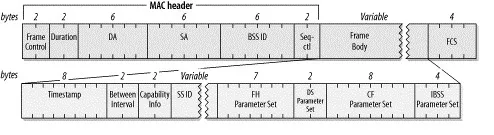
Probe response frames do not include the TIM (Traffic Indication Map) information element because the stations sending probe requests are not yet associated with the network.
The WLAN client or station that transmitted the last beacon frame is responsible for responding to incoming probe requests.
Continue Learning Wi-Fi MAC Layer Essentials
- WLAN Adhoc Vs Infrastructure Mode
- WLAN Association Request Response Frame
- WLAN Authentication De-authentication Frame
- WLAN Beacon Frame
- WLAN Channels Vs. Frequencies
- WLAN Class 1, 2, and 3 Frames
- WLAN DCF vs PCF : Key differences
- WLAN Re-association Request Response Frame
- WLAN RTS and CTS Frames
- SIFS, PIFS, DIFS, EIFS, and AIFS in WLAN : Key differences
Explore Legacy Wi-Fi Versions (IEEE 802.11b/a/g)
- WLAN Basics Tutorial
- WLAN Physical Layer: 802.11a PHY
- WLAN MAC Layer Part-1
- WLAN MAC Layer Part-2
- WLAN Security Basics, WEP Protocol and Wi-Fi Checklist
- WiFi Radio Frequency Channels: 2.4 GHz, 5 GHz, and 4.9 GHz
- WiFi Roaming: Understanding the Basics