
What is Wavelength Blocker and its Function in Fiber Optics
Advertisement
A wavelength blocker is an optical networking device that selectively removes or blocks specific wavelength channels from a multiplexed optical signal. Used in DWDM and optical transport networks, wavelength blockers improve network flexibility, bandwidth management and channel routing without affecting other transmitted wavelengths. Let us explore its functions particularly within Reconfigurable Optical Add-Drop Multiplexers (ROADMs).
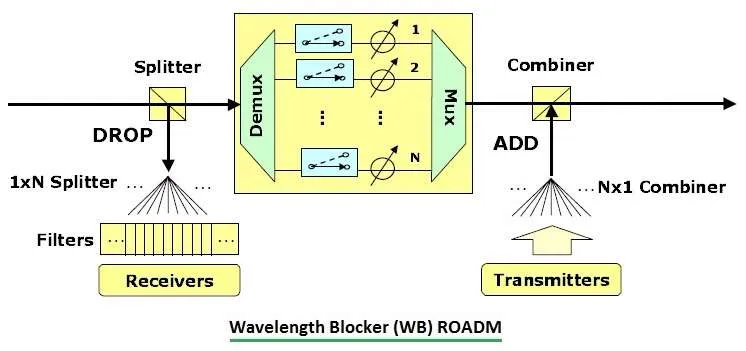
The image above illustrates a Wavelength Blocker (WB) ROADM. Let’s explore the key features of this type of ROADM:
-
Dynamic Channel Equalization: It functions as a dynamic channel equalizer, ensuring signal strength consistency across different wavelengths.
-
ON/OFF Switch Functionality: The maximum attenuation setting provides a complete cutoff functionality, effectively acting as an ON/OFF switch for specific wavelengths.
-
‘Broadcast and Select’ Architecture: It utilizes a ‘broadcast and select’ architecture, allowing any input wavelength to be routed to any output.
-
Long Haul Network Applications: It’s primarily used in long-haul fiber optic networks where signal degradation is a significant concern.
-
Channel Capacity: Typically handles around 80 channels with a spacing of approximately 50GHz between them.
-
Colored Ports: The ports are ‘colored,’ meaning they are designed for specific wavelengths.
-
Cost and Functionality: It tends to be expensive compared to other ROADM types, especially considering the limited functionalities offered.
-
Legacy Systems: Commonly found in older fiber optic systems.
Explore More Optical Networking Components
- Optical Switching Basics
- Optical Transceiver Explained
- Optical Add-Drop Multiplexer (OADM) Explained
- What is a ROADM (Reconfigurable Optical Add-Drop Mux)?
- Optical Fiber Connectors (FC, SC, ST, LC, DIN)
- Optical Amplifiers & Repeaters
- Optical Wavelength Converters
- Optical Filter Basics
- Optical Equalizer Basics
- Optical Transimpedance Amplifier
- Optical Sensors: Advantages & Disadvantages
- Optical Biosensors: Working, Types & Applications