
What is WAAS : Advantages and Disadvantages
Advertisement
WAAS (Wide Area Augmentation System) is a satellite based navigation enhancement system that improves the accuracy, integrity, and availability of GPS signals. Its advantages include higher positioning accuracy and increased navigation reliability, while its disadvantages include regional coverage limitations and dependence on satellite infrastructure.
Architecture of WAAS (Wide Area Augmentation System)
The WAAS system was developed by the U.S. Federal Aviation Administration and has been operational since 2003. It is the first satellite-based augmentation system providing both vertical and horizontal navigation capabilities for aircraft.
GPS signals can be affected by errors due to ionospheric disturbances, timing issues, and satellite orbit inaccuracies. WAAS is designed to provide corrections to these GPS signal errors, making it particularly useful in open land and marine environments.
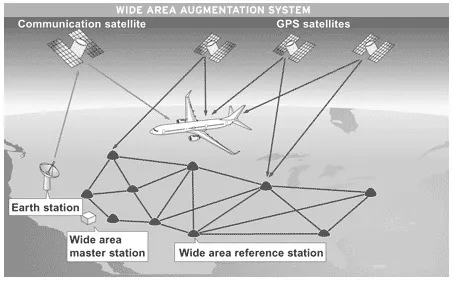
WAAS system architecture
The WAAS network architecture includes GPS satellites, two master stations, geostationary satellites, and numerous reference stations spread across the USA. This system is designed to enhance position accuracy by providing GPS signal corrections. It gathers data from the reference stations and generates a GPS correction message, which is then broadcast by the geostationary satellites. Because this message adheres to the basic signal structure of GPS, it can be easily processed by WAAS-enabled GPS receivers.
Similar satellite based differential systems include MSAS (Multi-Functional Satellite Augmentation System) in Japan and EGNOS (Euro Geostationary Navigation Overlay Service) in Europe.
Benefits or Advantages of WAAS
- Improved Accuracy: WAAS receivers offer position accuracy of less than 3 meters, which is better than typical GPS (~15 meters) and differential GPS (~3 to 5 meters) systems.
- High Availability: It provides this level of position accuracy 95% of the time.
- Cost-Effective: No additional hardware is needed to use the WAAS service, reducing initial installation costs.
- Free Service: Users are not required to pay service charges to use WAAS.
- Error Correction: WAAS corrects GPS signal errors.
- Extended Coverage: WAAS offers wider coverage compared to land-based differential GPS systems, both inland and offshore.
Limitations or Drawbacks or Disadvantages of WAAS
- Limited Coverage Area: WAAS satellite coverage is restricted to regions with installed ground reference stations. Consequently, even if GPS users receive the WAAS signal, it might not improve accuracy if they are outside the coverage area. For example, the service is available in North America but not in South America due to the lack of ground reference stations there.
- Line of Sight Issues: Obstructions like trees or mountains can block the WAAS signal, as it requires a clear line of sight to the geostationary satellites over the equator.
- Incomplete System Coverage: Coverage is limited away from the geostationary satellite locations.
- Stringent Regulations: The accuracy of WAAS may not be sufficient for applications requiring stricter precision due to regulatory constraints. More accurate systems, such as Local Area Augmentation Systems, may be necessary.
- Space Environment Vulnerability: The space segment of WAAS is vulnerable to space debris and solar storm threats.
Summary
WAAS significantly improves GPS navigation by delivering enhanced positioning accuracy and reliability for aviation, surveying, agriculture, and other precision-based applications.
Continue Learning GPS Technology
- GPS System Basics
- GPS Frame Structure
- GPS Satellite Block Diagram & its modules
- GPS NMEA Data Format : GPGGA, GPGLL, GPVTG, GPRMC
- Active Vs. Passive GPS Tracking : Key differences
- How GPS Tracking System Works
- What is GPS Spoofing and How to Prevent it?
- GPS : Key Advantages & Disadvantages
- What is Differential Global Positioning System
Continue Learning GNSS Technology
- GNSS : Key Advantages & Disadvantages
- GNSS Architecture & Data Processing in 5G Mobile Phone
- GPS & GNSS Frequency Bands
- GNSS Data Formats: NMEA, RINEX, RTCM, and More
- GNSS Signal Codes
Continue Learning Satellite Communication Technology
- Satellite Communication Basics Tutorial
- GEO Vs. LEO Vs. MEO Satellite Types
- Apogee and Perigee in Satellite Communication
- Satellite Capacity Allocation Types
- Satellite Frequency Bands
- Satellite Transponder Components & its function
- Satellite Bus vs Payload : Understand functions
- Satellite Ground Station Basics
- Satellite System Security Mechanisms & Standards
- Satellite Parking Lot Concepts and Procedures
- Satellite Launching Procedure and Processes
- Telemetry, Tracking and Command (TTC) in Satellite System