
V2X Explained: How Cars Talk to Save Lives using UWB & GPS
Advertisement
Introduction : For the last decade, we have seen how car used its own sensors such as radar or camera to look around and make decisions. The next evolution is safety using cooperative driving powered by V2X (Vehicle to Everything) with the help of UWB and GPS. V2X allows vehicles to stop guessing what other drivers are doing and start asking them. By sharing data 10 times per second, cars can coordinate maneuvers, see around blind corners, and prevent accidents that standard sensors would miss. Ultra-Wideband is emerging as a transformative technology in the evolution of V2X communication.
What is V2X?
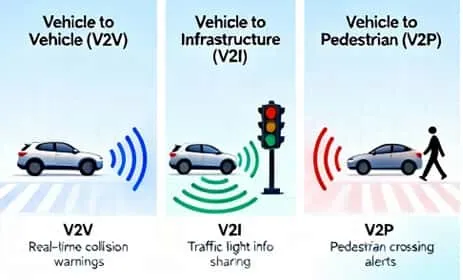
It is an umbrella term used for wireless data exchange between vehicle and its surroundings. It breaks down into three specific conversations.
- V2V (Vehicle-to-Vehicle): Cars exchanging data with each other such as “I am braking hard,” or “I am changing lanes” etc.
- V2I (Vehicle-to-Infrastructure): Cars talking to traffic lights, road signs or toll booths such as “Green light turns red in 3 seconds” etc.
- V2P (Vehicle-to-Pedestrian): Cars detecting the smartphones of pedestrians or cyclists to prevent collisions at crosswalks.
How Conversation works
In US, V2X broadcasts basic safety messages and in Europe it broadcasts cooperative awareness messages,
- Every connected car broadcasts digital packet approximately every 100 ms. The packet contains car’s identity, gps position, speed, heading and acceleration status.
- Your car receives these packets from all nearby vehicles, even those hidden behind trucks or buildings.
- The car’s Autonomous Navigation System (ANS) calculates the trajectories of these other vehicles. If a trajectory intersects with yours, it triggers a warning or automatic braking.
UWB Solution : Trust Layer for V2X
As automakers and cities increasingly adopt connected-vehicle systems, UWB enhanced V2X will play a pivotal role in reducing collisions, improving pedestrian protection, and enabling more intelligent, cooperative mobility. Ultimately, by giving vehicles the ability to “talk” with unprecedented precision, UWB brings us closer to a transportation ecosystem where safety is proactive rather than reactive and where countless lives can be saved through smarter communication.
Standard V2X relies on GPS data. If a car’s GPS drifts, or if a malicious hacker “spoofs” (fakes) a GPS signal, a car might think a vehicle is in a safe lane when it is actually on a collision course. UWB incorporates anti-spoofing mechanism to create trust layer for V2X Communication.
- Anti-Spoofing Verification
- Scenario : A hacker driving behind you broadcasts a fake V2V message claiming they are in front of you and slamming on the brakes. A standard V2X system might force your car to emergency brake for a “ghost car,” causing a pile up.
- Solution : Your car receives the V2V message but uses UWB to physically measure the distance and direction of the signal source. It realizes the radio waves are coming from behind, not in front. It identifies the data as fake and ignores it.
- High Speed Platooning
- Scenario: Trucks driving in a tight convoy (i.e. platoon) to save fuel by reducing wind resistance. They drive with only a few meters of separation at highway speeds.
- Usage : GPS is not accurate enough (3 to 5 meters error) to maintain a 4 meter gap safely. UWB provides 10 cm accuracy with less than 10 ms latency. This allows the following truck to react to the lead truck’s braking instantly, faster than human reaction time.
- Intersection Safety
- Scenario : Pedestrian steps out from behind a parked delivery van. Your car’s camera and radar are blocked by the van.
- Usage : The pedestrian’s phone broadcasts a V2P signal. Your car picks it up through the van. Using UWB ranging, the car calculates that the phone is moving into the street and applies the brakes before the pedestrian even becomes visible.
Comparison V2X Vs. Traditional Sensors
| Feature | Traditional Sensors (Camera/Radar) | V2X + UWB (Co-operative) |
|---|---|---|
| Line of Sight | Required, Can not see through trucks/walls | Not required, See around corners |
| Range | Limited by visual horizon | Extended, radio range up to 300 meters+ |
| Blind Spots | High, Blocked by obstacles | Zero, All connected devices are visible |
| Security | N/A, passive observation | High, Verifies identity and position |
Summary : By providing precise, low latency, and secure ranging between vehicles and infrastructure, UWB helps close critical safety gaps that traditional sensors and radio technologies struggle with; especially in dense urban environments, blind intersections and situations requiring centimeter level accuracy.
Continue Learning UWB Technology
- UWB Basics Tutorial
- UWB Physical & MAC Layers
- UWB Frame Structure
- Understanding UWB Networks
- UWB Radar Tutorial
- UWB : Key Advantages & Disadvantages
- UWB Anchor Vs Tag : Key differences
- UWB Antenna Types & their benefits