 RF
RFUWB vs GPS: Understanding the Key Differences
Advertisement
Introduction : In a world where location tracking powers everything from smartphone maps to warehouse asset management, two technologies dominate the conversation: Ultra Wideband (UWB) and Global Positioning System (GPS). While both provide location data, they are built on entirely different principles and each shines in different scenarios. UWB uses ultra short radio pulses and local infrastructure to deliver extremely precise, real time positioning (often within a few centimetres), even indoors or in complex environments with obstacles. By contrast, GPS relies on signals from satellites orbiting the earth to pinpoint positions globally, offering broad outdoor coverage but with lower accuracy (usually within several metres). Understanding the difference between UWB and GPS is crucial for choosing the right positioning solution.
What is UWB?
UWB (Ultra Wide Band) technology utilizes a spectrum larger than 500 MHz. In 2002, the FCC approved the use of unlicensed spectrum within the 3.1 to 10.6 GHz range for UWB applications.
It employs short duration EM (Electro Magnetic) pulses for high speed data transfer over a wide bandwidth. UWB adheres to the IEEE standard 802.15.4a/z. Due to its wide bandwidth, it can be used for high data rate (~ 27 Mbps) communication. It’s also popular due to its lower latency, low power consumption and high immunity to various interferences.
Unlike Wi-Fi or Bluetooth, which measure signal strength (RSSI), UWB measures Time of Flight (ToF) of radio pulses.
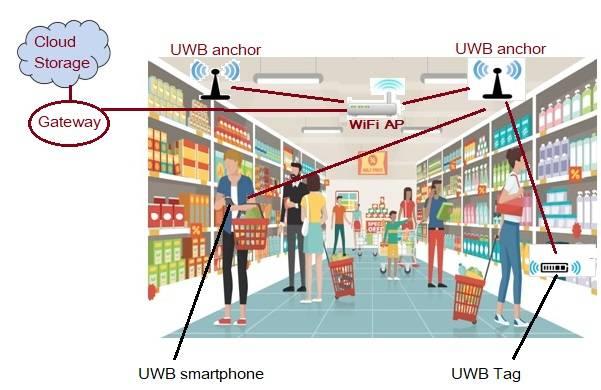
The figure depicts a UWB network consisting of UWB anchors installed at various places. These anchors communicate with UWB tags and UWB smartphones, UWB lights and WiFi APs. The WiFi AP or router is interfaced with the cloud via a gateway. UWB technology is used for target sensor data collection from motion sensors, temperature sensors, light sensors etc. It can also be used for precise location and tracking applications.
- Strength : It provides centimeter level accuracy. It is impervious to noise spikes and works perfectly indoors, even in cluttered factories with metal (i.e. multi-path environments).
- Weakness : It requires local infrastructure (anchors) to function; it can not work “everywhere” like GPS.
What is GPS?
GPS was initially used by US defense forces. Later, it gained popularity in many commercial applications. The initial spacecraft designed for GPS application was launched in 1978. A full constellation of 24 satellites was operational in 1993.
GPS technology uses a GPS satellite constellation installed around Earth, which communicates with GPS receiver units on the Earth. It’s used for various applications such as determining position, navigation, tracking people and things, road surveying systems, mapping the world, calculating precise timing, boating, hiking, GPS based drones, GPS based smartwatches, etc.

There are three major components of GPS: space segment, control segment and user segment.
In the future, GPS will find applications in smart homes, crime prevention, robotics, intelligent traffic systems, disaster control, integration with other wireless technologies, etc. The figure depicts a GPS tracking system.
- Strength : It works everywhere outdoors on Earth without local infrastructure.
- Weakness : It fails indoors because satellite signals can not penetrate roofs or thick walls. It lacks precision too.
Difference between UWB and GPS
The following table mentions the difference between UWB and GPS with respect to various parameters.
| Features | UWB | GPS |
|---|---|---|
| Primary Use Case | Indoor Asset Tracking & Secure Ranging (Micro-Location) | Outdoor Navigation (Macro-Location) |
| Frequency Band | 3.1 GHz – 10.6 GHz | L-Band (1.2 GHz, 1.5 GHz) |
| Coverage area | Local (Short Range, Typically 10-70 meters per anchor) | Global (Anywhere with line of sight to sky) |
| Accuracy | in centimeters | 5-20 meters |
| Security (Physical layer) | High (Cryptographic timestamps prevent relay attacks) | Low (Susceptible to Spoofing) |
| Data Rate | High (27 Mbps - can transfer data plus video) | Very Low (50 bps - Navigation data only) |
| Reliability | Strong immunity to multi-path and interference | Very sensitive to obstructions |
| Location service latency | Less than 1 ms (Typically) to get XYZ | 100 ms (Typically) to get XYZ |
| Scalability or density | > 10’s of thousands of tags | Unlimited |
| Measurement Method | Tof (Time of FLight) between Anchors and Tags (Two Way Ranging) | ToF from satellites (Triangulation) |
| Interference Immunity | High (Resistant to multipath and fading) | Low (Easily jammed or spoofed) |
| Update Rate | fast (Up to 1000 Hz) | Slow (1-10 Hz) |
| Power Consumption | Low (< 10 mWatt for sensing) | High (Receiver must be active/locking) |
Summary
Ultimately, the choice between UWB and GPS depends on your location-tracking needs. If you require high precision, low latency and reliable positioning in indoor or signal challenged environments, UWB stands out as an ideal solution. On the other hand, if you need global coverage and outdoor navigation across wide geographic areas, GPS remains the go-to technology. For many modern use cases from asset tracking in warehouses to mixed indoor/outdoor logistics; a hybrid approach combining both UWB and GPS can deliver the best of both worlds.
Advertisement


