
What is Riser Cable: Advantages and Disadvantages
By RF Wireless Expert Team
Advertisement
A riser cable is a fire-resistant communication cable designed for vertical installation between floors in commercial and residential buildings. Its advantages include improved fire safety and cost-effective installation, whereas its disadvantages include restrictions for air-handling spaces and lower fire resistance than plenum-rated cables.
Key features of Riser Cable
- Riser (CMR) rated cable complies with UL-1666 standards.
- Primarily used in commercial buildings.
- A “riser” refers to the vertical space used by telecommunications infrastructure to connect different floors within a building.
- OFNR (Optical Fiber Non-Conductive Riser) cables lack conductive metal structures and are approved for riser applications. Most fiber optic cables are inherently non-conductive, being made of materials like glass or plastic.
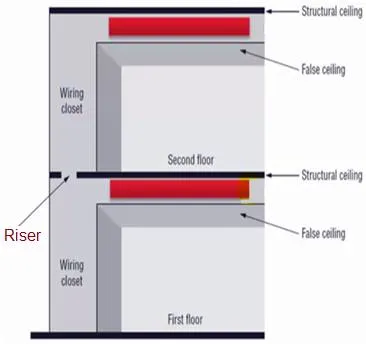
- Riser cables are designed for vertical tray applications, such as cable runs between floors through cable risers or in elevator shafts.
- A key characteristic is their self-extinguishing property.
Benefits or Advantages of Riser Cables
- Fire Resistance: Prevents fire from spreading between floors due to its fire-resistant properties.
- Vertical Connectivity: Suitable for connecting floors via vertical cable runs.
- Self-Extinguishing: These cables are designed to self-extinguish in the event of a fire.
- Versatile Availability: Twisted-pair, coaxial, HDMI, and DVI versions of cables are manufactured in riser variants.
Drawbacks or Disadvantages of Riser Cables
- Less Strict Fire Requirements: Riser cables don’t have as stringent fire safety requirements as plenum cables. As a result, plenum cables can always be used as a replacement for riser cables, offering a higher level of fire protection.
Summary
Riser cables provide safe and reliable structured cabling for multi story buildings by meeting vertical fire safety requirements while supporting voice, data, and networking infrastructure. Their installation advantages make them widely used, although proper cable selection remains essential for building code compliance.
Continue Learning RF & Coaxial Cables
- RF Cables: Advantages and Disadvantages
- RF Semi-Rigid vs Flexible Cables
- Coaxial Cable Types
- Coaxial Cable: Advantages & Disadvantages
- Wire vs Cable Differences