
What is Transient Limiter:Definition & Specifications
Advertisement
A transient limiter is an electronic protection device designed to suppress voltage surges, spikes and transient disturbances that could damage sensitive circuits. Widely used in communication systems, power electronics, industrial equipment and networking devices, transient limiters improve reliability and protect against electrical overstress conditions. Let us understand its function and explore specifications of transient limiter from Keysight Technologies.
Here’s a breakdown of what a transient limiter does:
- As the name suggests, it blocks high-frequency transients.
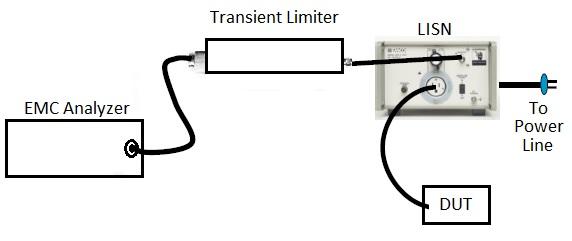
- It’s typically used in conjunction with a LISN (Line Impedance Stabilization Network) and an EMC analyzer.
The primary goal here is to safeguard the EMC analyzer from potentially damaging large transients.
This is crucial because the Equipment Under Test (EUT) can generate significant spikes when it’s switched on and off.
- Essentially, the transient limiter functions as both a filter and an attenuator.
Keysight Transient Limiter Specifications
Here’s a look at the specifications for the model 11947A transient limiter from Keysight:
- It can withstand a power surge of 10 Kilowatts for 10 microseconds.
- It supports a frequency range from 9 kHz to 200 MHz.
- It introduces an insertion loss of 10 dB.
- It can handle a maximum continuous input power level of 2.5 Watts.
Advertisement


