
What is Half Bridge Converter : Advantages and Disadvantages
Advertisement
A half bridge converter is a switched-mode DC-DC power converter that uses two switching devices and a transformer to provide efficient power conversion. It is commonly used in medium-power applications such as telecom equipment and industrial power supplies. Advantages include good efficiency and transformer utilization, while disadvantages include capacitor balancing requirements and increased circuit complexity.
What is DC-DC Converter
It is an electronic circuit whose main function is to modify one potential difference (voltage) level to another. Essentially, it’s a voltage regulator consisting of switches, an inductor, and a capacitor for power conversion.
DC-DC converters have numerous applications and are broadly divided into two types based on isolation between input and output circuits:
- Isolated DC-DC Converter
- Non-isolated DC-DC Converter
Isolated DC-DC converters are further categorized into:
- Flyback
- Forward
- Half-Bridge
- Full-Bridge
- Push-Pull
Half Bridge Converter Circuit and Working Operation
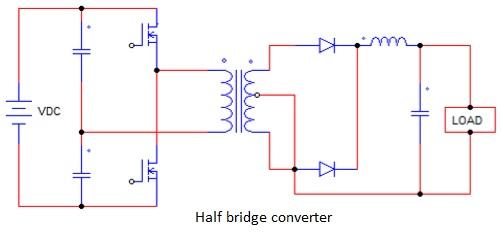
Figure-1 : Half bridge converter circuit
The figure above illustrates a typical half-bridge converter circuit. Similar to flyback and forward converters, it’s a type of DC-DC converter capable of providing an output voltage that is either higher or lower than the input voltage, while also providing electrical isolation via a transformer.
While more complex than flyback or forward types, the half-bridge (HB) chopper design can deliver significant output energy using smaller and more cost effective components.
The HB control chopper has gained popularity for small output voltage conversion due to its excellent features, boasting efficiencies around 90% at lower output voltages. This converter allows for the analysis of both static and dynamic characteristics. The DC voltage transfer ratio can be achieved in both discontinuous and continuous conduction modes, allowing for the determination of the boundary between these modes and the level of current in the transformer.
Advantages of Half-Bridge Converter
- Magnetic cores are small in size.
- There’s no gap in the magnetic path.
- Generates less stray magnetic field.
Disadvantages of Half-Bridge Converter
- Operates at half the supply potential, meaning the switching transistors operate at twice the collector current compared to a basic push-pull scheme.
- Not suitable for current mode control.
Summary
Half bridge converters provide efficient isolated power conversion for medium-power systems. Advantages include compact design and good efficiency, while disadvantages include complex control and capacitor balancing challenges.
Advertisement


