
What is Full Bridge Converter : Advantages and Disadvantages
Advertisement
A full bridge converter is a high-power DC-DC converter topology that uses four switching devices arranged in a bridge configuration to efficiently transfer energy through a transformer. It is widely used in industrial power supplies, EV chargers, and telecom systems. Advantages include high power capability and efficiency, while disadvantages include increased circuit complexity and cost.
What is DC to DC Converter?
A DC-DC converter is an electronic circuit that modifies one DC voltage level to another. Essentially, it acts as a voltage regulator, utilizing switches, inductors, and capacitors to efficiently convert power. These converters are vital in a wide range of applications.
DC-DC converters are categorized based on whether they provide isolation between the input and output circuits:
- Isolated DC-DC Converters: Provide electrical isolation. Examples include:
- Fly-back
- Forward
- Half Bridge
- Full Bridge
- Push-Pull
- Non-Isolated DC-DC Converters: Do not provide electrical isolation.
Full Bridge Converter Circuit and Working Operation
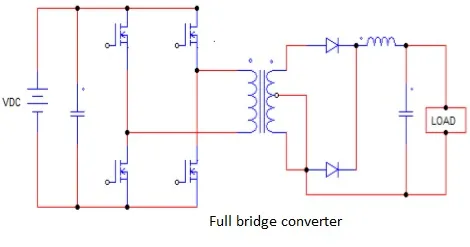
The figure above illustrates a typical full bridge converter circuit. This type of converter is known for its efficiency and can be adapted as a zero voltage switching (ZVS) phase-shift converter. In this configuration, each side of the bridge is driven by a square wave, and the relative phase shift between these square waves is adjusted to control the amount of power transferred.
The full bridge converter is a popular DC-DC chopper choice due to its:
- Low circulating reactive energy
- Moderate device stresses
- ZVS operation
- High efficiency
- High switching frequency
By connecting a DC blocking capacitor and a storage inductor in series with the primary winding, the current on the primary side can be reduced to zero during the freewheeling interval.
Advantages of Full Bridge Converter
- High Voltage Applications: Well-suited for applications requiring high voltage levels.
- Reduced Voltage Ripple: Offers slightly less voltage ripple compared to a half-bridge converter.
- Full Wave Utilization: Employs four diodes to effectively change the polarity of the entire waveform, rather than just clipping off half of it.
Disadvantages of Full Bridge Converter
- Lower Efficiency: Typically has a lower efficiency (around 95%) compared to a half-bridge converter (around 99%).
- Increased Complexity: Contains an additional segment to connect the ground point to the load, making it more complex than a half-bridge converter.
- Higher Losses and Noise: The presence of more switching elements can result in increased losses and noise compared to a half-bridge design.
Summary
Full bridge converters provide efficient power conversion for high-power applications. Advantages include high efficiency and excellent transformer utilization, while disadvantages include complex control circuitry and higher implementation costs.