
What is a Quantum Dot Solar Cell : Advantages and Disadvantages
Advertisement
A quantum dot solar cell is an advanced photovoltaic device that uses semiconductor nanocrystals to convert sunlight into electrical energy. Its advantages include tunable light absorption and lower manufacturing potential, whereas its disadvantages include limited long-term stability and ongoing commercialization challenges.
Quantum Dot Solar Cell Structure & Working Principle
Quantum dots excel at capturing excess photon energy, which is usually lost as heat, through a process called multiple exciton generation.
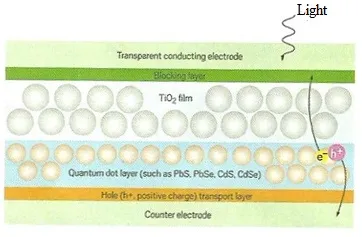
When light hits the quantum dot solar cell, it passes through a transparent electrode and onto a light-absorbing layer of quantum dots. This creates electron-hole pairs (e-/h+). These charged particles then separate and travel to their respective electrodes, generating an electric current.
Figure 1 illustrates the structure and working of a Quantum Dot Solar Cell.
Quantum dots are made of electro-optically active materials. Their size and composition determine which photon energy they interact with, allowing their absorption (and emission) wavelength to be tuned by adjusting the particle size. This tuning allows them to deliver multiple electron-hole pairs from a single photon – the multiple exciton generation. This allows quantum dot solar cells to operate at around 10% efficiency.
Quantum dots also have bandgaps that can be tuned across a broad range of energy levels by changing the quantum dot size.
Benefits or Advantages of Quantum Dot Solar Cells
- Favorable power to weight ratio: They provide a lot of power for their weight.
- High efficiency: They are capable of converting sunlight to electricity efficiently.
- Mass and area savings with flexibility for miniaturization: Due to their compact size and flexibility, they can be made smaller.
- Lower power consumption: They don’t require much power to operate.
- Versatility: They can be used in a variety of applications.
- Increased electrical performance at low production costs: They offer good performance without being expensive to manufacture.
- Integration into Buildings: They can be integrated into entire buildings, like windows, and not just on rooftops.
Drawbacks or Disadvantages of Quantum Dot Solar Cells
- Toxicity: CdSe-based quantum dot solar cells are highly toxic and require a very stable polymer shell for safety.
- Degradation: Their degradation increases in aqueous and UV conditions. This aspect is currently being studied.
- Optical Properties: The protective shells can alter the optical properties of the quantum dots. It is also difficult to precisely control the size of the particles.
Summary
Quantum dot solar cells offer significant potential for next-generation renewable energy through improved light absorption and manufacturing flexibility, although commercial maturity is still evolving.