
What is a Perovskite Solar Cell : 5 Advantages and Disadvantages
Advertisement
Perovskite solar cells are next-generation photovoltaic devices that use perovskite-structured semiconductor materials to convert sunlight into electricity with high efficiency. They offer lower manufacturing costs and excellent performance, making them promising alternatives to conventional silicon solar cells despite ongoing durability challenges.
Perovskite Solar Cell Structure & working
This type of solar cell utilizes a perovskite-structured compound, which is typically a hybrid organic-inorganic lead or tin halide-based material. It functions as the light-harvesting active layer within the cell.
Figure 1 depicts the structure of a standard (non-inverted) perovskite solar cell.
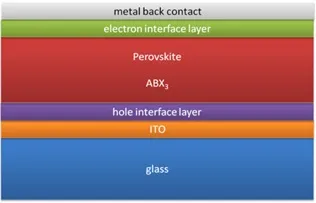
Perovskite structure
As shown, a perovskite solar cell consists of several layers from top to bottom:
- Metal back contact
- Electron interface layer
- Perovskite ABX3
- Hole interface layer
- ITO (Indium Tin Oxide)
- Glass
How Perovskite Solar Cells Work
Figure 2 illustrates the working principle of a Perovskite solar cell.
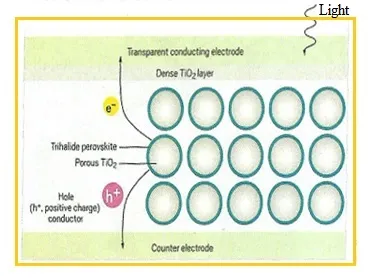
Working of Perovskite solar cell
- Incident light passes through and is absorbed by the perovskite material, creating electron-hole (e-/h+) pairs.
- Due to the low binding energy, the charged particles separate and diffuse through the charge conducting layers.
- The charges are then collected by the respective electrodes, which generates an electric current.
Benefits (Advantages) of Perovskite Solar Cells
- Direct Optical Band Gap: Perovskite material offers a direct optical band gap of around 1.5eV.
- Long Diffusion Length & Lifetimes: They offer long diffusion lengths and long minority carrier lifetimes.
- Broad Absorption Range: They possess a broad absorption range, spanning from the visible to near-infrared spectrum (800 nm), and a high absorption coefficient (105 cm-1).
- High Efficiency: Perovskite cells can deliver efficiencies of over 22 percent.
- Inexpensive & Simple Manufacturing: Perovskite materials, such as methylammonium lead halides, are relatively inexpensive and simple to manufacture.
- Favorable Electrical Properties: They exhibit a high dielectric constant, a fast charge separation process, long transport distance for electrons and holes, and a long carrier separation lifetime.
- Versatile Applications: This low-cost material can be used to convert building windows, car roofs, and walls into solar power generators.
- Cost-Effective Material Usage: Perovskite requires less material to absorb the same amount of light compared to silicon, making it cheaper overall.
Drawbacks (Disadvantages) of Perovskite Solar Cells
- Degradation: The degradation issue of methyl ammonium lead iodide Perovskite requires further study.
- Film Quality: Main challenges relate to film quality and thickness.
- Environmental Sensitivity: The perovskite material can break down quickly when exposed to heat, moisture, snow, etc.
- Toxicity: The material can be toxic in nature.
Summary
A perovskite solar cell is a next-generation photovoltaic device that uses perovskite materials to efficiently convert sunlight into electricity. It offers high efficiency and lower manufacturing costs than conventional solar technologies.
Continue Learning️ Solar Cell Fundamentals & Comparisons
- Solar Cell Types Comparison
- Advantages and Disadvantages of Solar Cells
- Photodiode vs Solar Cell: Understanding the Differences
- Solar Cell Efficiency Calculator