
What is Quantum Dot Solar Cell : Structure, working, Advantages, Disadvantages
Advertisement
Quantum Dot Solar Cells (QDSCs) are an advanced type of third-generation photovoltaic technology that use semiconductor nanocrystals, known as quantum dots, as the light absorbing material. These quantum dots possess unique optical and electronic properties due to the quantum confinement effect, allowing their band gap to be tuned by simply changing their size.
This enables QDSCs to absorb a broader range of the solar spectrum compared to conventional silicon solar cells, making them a promising solution for achieving higher energy conversion efficiency. Their low cost fabrication, flexibility, and potential for multiple exciton generation have made them a significant area of research in renewable energy.
Quantum Dot Solar Cell Structure & its working
Quantum dots are incredibly small semiconductor particles, measured in nanometers. Their tiny size gives them unique optical and electronic properties compared to larger particles. Different types of quantum dots emit specific frequencies when exposed to electricity or light. The emitted frequency can be fine-tuned by adjusting the size, shape, and material composition of the dots.
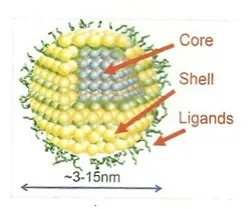 Figure 1: Structure of Quantum Dots
The figure above shows a typical quantum dot structure. Often, Cadmium Selenide (CdSe) forms the inner core, surrounded by an outer shell like Cd 1-x Zn x S. This is then often coated in silica to prevent oxidation. The outer shell acts as an absorber.
When a photon interacts with a quantum dot, an electron moves from its valence band to the conduction band, leaving behind a “hole” in the valence band.
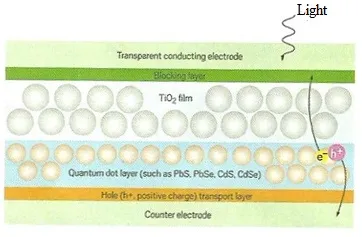 Figure 2: Working of a Quantum Dot Solar Cell
The figure above depicts how a quantum dot solar cell functions. Quantum dots can capture excess photon energy, which is normally lost to heat, through a process called multiple exciton generation. Incident light passes through the transparent electrode of the solar cell and onto the light-absorbing layer of quantum dots, creating electron-hole pairs (e-/h+). These charged particles then separate and travel to their respective electrodes, generating an electric current.
Benefits or Advantages of Quantum Dot Solar Cells (QDSCs)
- Absorbs More Sunlight: QDSCs can absorb ultraviolet, visible, and infrared light, allowing them to utilize a larger portion of the solar spectrum.
- High Efficiency Potential: Their unique quantum dot properties can improve energy conversion efficiency and may produce more electricity than conventional solar cells.
- Low Manufacturing Cost: These solar cells can be made using simple solution based techniques, making large scale production more affordable.
- Flexible and Lightweight: QDSCs can be fabricated on flexible materials, making them suitable for portable, wearable, and curved electronic devices.
- Tunable Band Gap: The size of quantum dots can be adjusted to optimize light absorption for different applications and environmental conditions.
Drawbacks or Disadvantages of Quantum Dot Solar Cells (QDSCs)
- Toxic Materials: Many QDSCs contain cadmium or lead, which can be harmful to human health and the environment if not handled properly.
- Limited Stability: Their performance decreases over time due to exposure to moisture, oxygen, heat, and sunlight.
- Lower Commercial Maturity: QDSCs are still under development and are not yet as widely available or reliable as silicon solar cells.
- Complex Fabrication: Producing high quality quantum dot layers requires careful control during the manufacturing process.
- Environmental Concerns: Safe disposal and recycling are necessary because some materials used in QDSCs can cause environmental pollution.
Summary
Quantum Dot Solar Cells represent a promising advancement in solar energy technology by offering tunable optical properties, enhanced light absorption, and the potential for higher efficiency at lower manufacturing costs.
Explore Quantum Sensors, Dots & Solar Cells
- Quantum Sensing Using Quantum Sensors
- Quantum Sensors: Advantages and Disadvantages
- Quantum Dot Solar Cells: Advantages and Disadvantages
- Photodiode Quantum Efficiency Calculator