
What is Pulse Transformer: Advantages and Disadvantages
Advertisement
A pulse transformer is a specialized transformer designed to transfer rectangular electrical pulses with minimal distortion while providing electrical isolation. It is widely used in switching power supplies, communication circuits, gate drive applications, and digital signal transmission.
Pulse Transformer Circuit and working operation
Introduction: A pulse transformer is composed of a primary winding and one or more secondary windings. It’s specifically designed for pulsed mode triggering applications.
Figure 1 illustrates the isolation achieved through the use of a pulse transformer.
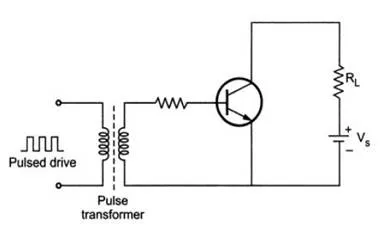
As the diagram shows, the triggering circuit (on the left) is electrically isolated from the BJT (Bipolar Junction Transistor) via the pulse transformer. This isolation is crucial because if the BJT experiences electrical damage, the triggering circuit remains unaffected and protected.
Benefits or Advantages of Pulse Transformers
- No External Power Required: Pulse transformers operate without the need for an external power source, simplifying the circuit design and reducing energy consumption.
- Simple to Use: They are relatively straightforward to implement and integrate into existing circuits.
Drawbacks or Disadvantages of Pulse Transformers
- Saturation at Low Frequencies: Pulse transformers tend to saturate at lower frequencies, limiting their use to higher-frequency applications.
- Signal Distortion: Due to magnetic coupling within the transformer, the signal can experience distortion.
Summary
A pulse transformer transfers fast electrical pulses while maintaining signal integrity and electrical isolation. It is commonly used in power electronics, communication, and switching applications.