
Piconet vs. Scatternet: Bluetooth Network Types Explained
Advertisement
This article explains the concepts of piconets and scatternets in Bluetooth networking, highlighting the key differences between these two network types.
Bluetooth Piconet
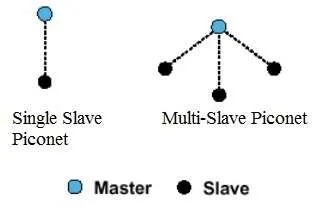
A piconet is the fundamental building block of a Bluetooth network. In a piconet, devices operate in either a master or slave role. There are two primary configurations:
- One master and one slave.
- One master and multiple slaves.
The master device is responsible for determining the channel and phase used for communication within the piconet.
As illustrated in Figure 1 (above), a piconet is limited to a maximum of 8 devices. This comprises one master device and up to seven slave devices.
Bluetooth Scatternet
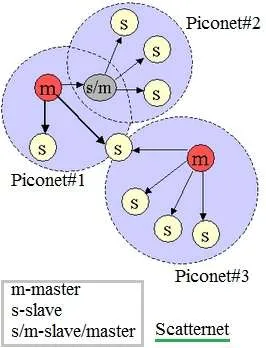
A scatternet is a Bluetooth network that consists of one or more interconnected piconets. Devices within a scatternet can function as a master or slave in different piconets simultaneously.
This network structure allows for a greater number of devices to share the same network area, which leads to more efficient use of available bandwidth.
Figure 2 (above) depicts the structure of a Bluetooth scatternet. Since a scatternet is essentially an interconnection of multiple piconets, it can support more than the 8-device limit of a single piconet.
Piconet vs. Scatternet: Key Differences
The following table summarizes the key differences between piconets and scatternets in Bluetooth networks:
| Feature | Piconet | Scatternet |
|---|---|---|
| Device Role | Device functions as either master or slave. | Device can function as master, slave, or both (master+slave) in different piconets. |
| Coverage Area | Smaller coverage area. | Larger coverage area. |
| Node Support | Supports a maximum of 8 nodes. | Supports more than 8 nodes. |
| Bandwidth Usage Efficiency | Less efficient use of available Bluetooth channel bandwidth. | More efficient use of available Bluetooth channel bandwidth. |
Continue Learning Bluetooth Basic Concepts
- What are new features in Bluetooth 6.3 Version
- Bluetooth GATT Vs. ATT Vs. GAP : Key Comparison
- Bluetooth Service Vs. Characteristic Vs. Descriptor
- Bluetooth Central Vs. Peripheral : Key Differences
- Bluetooth pairing Vs. Bonding Phase
- Bluetooth Notifications Vs. Indications
- Bluetooth Channel Sounding Vs. RSSI
- Bluetooth Error Codes Guide : Meanings, Causes & Fixes
- Bluetooth L2CAP and HCI : Key Differences
Continue Learning Bluetooth Technology
- Bluetooth Basics Tutorial
- Bluetooth Low Energy (BLE) Basics Tutorial
- Bluetooth Protocol Stack & Device State Diagram
- Bluetooth Physical Layer Modules
- Bluetooth MAC Layer Overview
- Bluetooth Channel Frequency List
- Bluetooth Network Security
- Bluetooth Low Energy (BLE) Connection Establishment Procedure
- Bluetooth Profiles: HFP, HSP, A2DP, AVRCP, PBAP & MAP
- Bluetooth Mesh Node Types & Protocol Stack Layer Functions
Compare Bluetooth With Other Technologies
- Bluetooth V5.0 Vs. V5.1 Vs. V5.2 Vs. V5.3
- Bluetooth Vs BLE : Key Differences
- Bluetooth Vs UWB Technology : Key Differences
- Bluetooth Vs Wi-Fi Vs UWB
Explore Deep Insight Bluetooth Technology
- Bluetooth AFH Explained: Adaptive Frequency Hopping & FAQs
- Bluetooth Error Recovery : ARQ, ACK, NAK
- Bluetooth Bit Stream Processing: HEC, CRC, FEC & More
- Bluetooth Routing: How Devices Know a Packet is for Them
- Bluetooth Flow Control: Understanding GO & STOP Bits
- Bluetooth Power Management: Sniff, Hold & Active Modes
- Bluetooth Packets Decoded: Structure, Types & Routing
- Decoding Bluetooth Packet Types: Control, ACL, SCO & eSCO