NFC vs. Qi: Wireless Charging standards differences
Advertisement
Introduction : Wireless charging technology is evolving fast, and two major standards viz. NFC wireless charging and Qi wireless charging are shaping the future of cable free power delivery. While Qi has dominated smartphones and accessories for years, NFC based wireless charging is emerging as a lightweight alternative for small IoT devices, wearables and smart accessories. This page will illustrate differences between NFC vs. Qi wireless charging standards including power output, range, compatibility and use cases. This can help consumers, developers and manufacturers to choose the right technology for their needs. In this guide, we break down how these two wireless charging methods work and what makes each one unique including pros and cons of each.
Qi (Wireless Power Consortium)
Qi is an open interface standard that defines wireless power transfer using inductive charging. It relies on a resonant inductive coupling between a transmitter coil (in the charging pad) and a receiver coil (in the device). It operates at a relatively low frequency range (100 to 205 kHz).
How it works
When a compatible device is placed on the pad, the transmitter detects it and sends a “digital ping.” If the handshake is successful, the pad drives current through its coil, creating a magnetic field. This field induces a voltage in the device’s coil, charging the battery.
Pros of Qi
Following are some of the benefits or advantages of Qi wireless charging.
- High Power Delivery: Qi is the standard for high drain devices. It supports up to 15 Watts (Extended Power Profile), which is essential for quickly charging smartphones and tablets.
- Mature Ecosystem: With over a decade of market dominance, Qi chargers are ubiquitous and found in furniture, vehicles and airports globally.
- Efficiency: For larger batteries (2000 mAh+), Qi is highly efficient at transferring energy quickly over short bursts.
Cons of Qi
Following are some of the drawbacks or disadvantages of Qi wireless charging.
- Size Constraints: Qi requires physical copper wire coils and ferrite shielding. The receiver coil generally needs to be at least 30 mm in diameter, making it too bulky for smart rings or slim styluses.
- Thermal Management: Inductive charging generates significant heat. If the coils are not perfectly aligned, efficiency drops and heat rises, potentially throttling charging speeds.
- Alignment Issues: Standard Qi requires the device to be placed precisely on the “sweet spot.”
- Note: The newer Qi2 standard addresses this using magnets, similar to Apple’s MagSafe, but the coil size limitation remains.
NFC (Near Field Communication)
NFC is best known for contactless payments (tap to pay) and pairing Bluetooth speakers. However, the NFC Forum officially added a Wireless Charging (WLC) specification that allows the single NFC antenna to transmit power alongside data. It operates at a much higher frequency (13.56 MHz).
How it works:
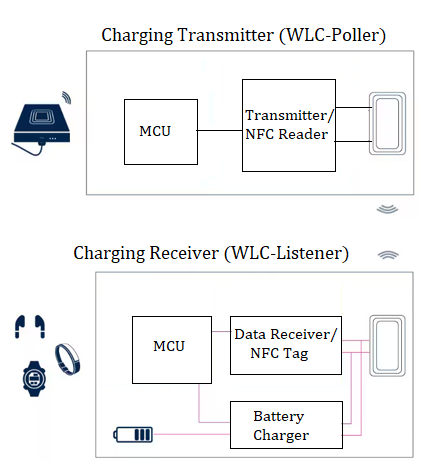
In this setup, the “Poller” (the charger) generates a magnetic field. The “Listener” (the device) modulates this field to communicate but also harvests energy from it. Due to higher frequency of operation, tiny size antenna can easily be printed on flexible PCB unlike bulky copper coil.
Pros of NFC Charging
Following are some of the benefits or advantages of NFC Wireless Charging.
- Miniaturization: This is NFC’s greatest strength. Antennas can be smaller than 1 cm^2 (approx. 14 mm diameter) and flexible, fitting into curved surfaces like earbuds or smart glasses.
- Combined Data and Power: Unlike Qi, which is power first, NFC is data first. A device can update its firmware, sync health data or authenticate a user while it is charging, without needing a separate handshake like bluetooth.
- Reduced Cost (BOM): If a device already uses NFC for pairing or payments, manufacturers can enable charging via software without adding extra hardware components.
Cons of NFC Charging
Following are some of the drawbacks or disadvantages of NFC wireless charging.
- Low Power Limit: The standard is capped at 1 Watt (and often operates closer to 250 to 500 mWatts). It is physically incapable of charging a smartphone; it would take days.
- Strict Range: While “Near Field” implies proximity, NFC charging drops off sharply after 2 cm.
Comparison between Qi and NFC
Following table compares Qi vs. NFC and mentions differences between them.
| Feature | Qi (Wireless Power Consortium) | NFC (NFC Forum WLC) |
|---|---|---|
| Operating Frequency | Lower, 85 - 205 KHz | Higher, 13.56 MHz |
| Max. Power Output | Up to 15 Watts (Standard) | Up to 1 Watt (Standard) |
| Antenna Type | Copper Wire Coil (Bulky) | PCB Trace / Printed Antenna (Tiny/Flexible) |
| Antenna Size | ~ 30 mm to 40 mm diameter | ~ 10 mm to 14 mm diameter |
| Data Transfer | Minimal (Signaling Only) | High ( Upto 848 Kbit/sec, bi-directional) |
| Alignment | Precise (Unless Magnetic) | Flexible (Orientation less critical) |
| Range | Tight (Contact to 4 mm) | Loose ( Up to 20 mm) |
| Primary Use Case | Smartphones, Tablets, Laptops | Smartwatches, Rings, Earbuds, Styluses |
Conclusion
In summary, NFC and Qi wireless charging serve different purposes rather than directly competing with each other. Qi remains the preferred standard for smartphones and high power devices, offering faster charging speeds and wider adoption, while NFC wireless charging excels in ultra low power applications where simplicity and compact design matter most.
References for further study
- NFC Forum. “Wireless Charging (WLC) Technical Specification.”
- Wireless Power Consortium. “Qi Specification Overview.”
Tags
Advertisement