
NFC Transceiver vs. MCU: Functions & Differences
Advertisement
Introduction : Based on the architecture of NFC systems, here is a detailed explanation of the functions of the NFC Transceiver and the Microcontroller Unit (MCU), followed by a comparison table.
NFC Transceiver
The NFC Transceiver (also called the Frontend or PHY) is the hardware component responsible for the Physical Layer of communication. It bridges the gap between the digital world of the circuit board and the analog world of wireless magnetic fields.
Key functions are as follows.
- RF Field Generation: In Reader mode, it drives the antenna coil to generate the 13.56 MHz magnetic field that powers passive tags.
- Modulation & Demodulation:
- Transmission (Tx): It takes digital bits from the MCU and modifies the amplitude of the carrier wave (ASK modulation) to send commands to the air.
- Reception (Rx): It detects tiny changes in the antenna’s voltage (Load Modulation) caused by a tag’s response, decodes them into digital bits, and sends them to the MCU.
- Framing & Error Checking: It handles low-level protocol requirements like adding Start/Stop bits (SOF/EOF), calculating Parity bits, and verifying the Cyclic Redundancy Check (CRC) to ensure the data packet is intact.
- Antenna Tuning: Many modern transceivers (like the ST25R3916) include features to automatically adjust internal capacitors to match the antenna impedance, ensuring maximum power transfer.
Example Part Nos:
- TRF7970A, ST25R3916
MCU (Microcontroller Unit)
The Microcontroller Unit (MCU) is the host processor that controls the transceiver. It runs the Software Stack and makes decisions based on the data received.
Key functions are as follows.
- Protocol Management: It runs the NFC Stack (software) that knows the rules for Type 2, Type 4, or Type 5 tags. It tells the transceiver what to send (e.g., “Send a READ command to Block 4”) but relies on the transceiver to actually send it.
- Data Processing (NDEF): It interprets the raw hex data received from the transceiver. For example, it parses the bits to realize “This is a URL for Google.com” or “This is a WiFi pairing code.”
- Application Logic: It decides what to do with the data. For example, if a correct ID is scanned, the MCU triggers a GPIO pin to unlock a door, turns on an LED, or sends the data to a PC via USB.
- Power Management: It puts the transceiver to sleep to save battery and wakes it up periodically to check for tags (Polling).
Example Part Nos:
- MSP430, STM32
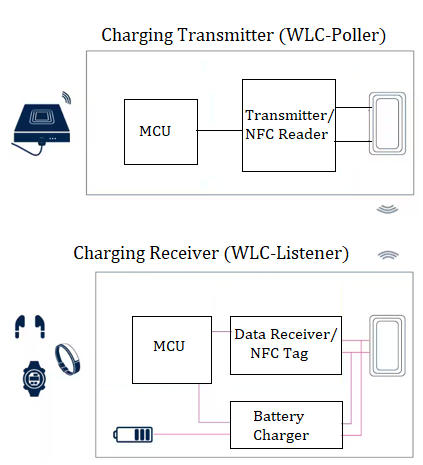
Comparison between NFC Transceiver Vs. MCU
Following table compares nfc transceiver vs. MCU and provides differences between them.
| Feature | NFC Transceiver | Microcontroller / MCU |
|---|---|---|
| Primary role | Physical Interface (PHY): Handles the radio waves and analog signals. | Logic & Control: Handles the decision making and application software. |
| Data Handling | Deals with Raw Frames: Sync bits, Parity, CRC and Modulation. | Deals with Payloads: NDEF messages, text, sensor values and files. |
| RF Responsibility | Directly drives the Antenna. Generates the 13.56 MHz carrier frequency. | Does not touch RF. Connects to the transceiver via digital wires (SPI/I2C/UART). |
| Intelligence | Low Level: Knows how to send a byte, but doesn’t know what the byte means. | High Level: Knows what the byte means (e.g., “Unlock Door”) but cannot transmit it wirelessly itself. |
| Configuration | Configured via Registers (setting bits to change modulation depth or gain). | Programmed via Code (C/C++ firmware) to run complex algorithms. |
| In reader | Generates the power/field to activate the tag. | Controls when the field is turned on/off and processes the read data. |
| In smart tag | Harvests energy from the reader to wake up the system. | Uses the harvested energy to perform tasks (e.g., measure temperature) and send data back. |
Summary
To sum up, NFC transceivers and MCUs serve complementary but distinct purposes in electronic system design. The NFC transceiver focuses on enabling secure, short range wireless communication, whereas the MCU handles computation, decision making and system control.
Tags
Advertisement


