 RF
RFWhat is I2C and I3C: Difference Between I2C and I3C
Advertisement
I2C (Inter Integrated Circuit) and I3C (Improved Inter Integrated Circuit) are widely used serial communication protocols for connecting sensors, processors and peripheral devices in embedded systems. I2C is 2-wire (SDA, SCL) synchronous serial interface while I3C is also 2-wire with improvement over I2C and SPI protocols.
What is I2C?
I2C, or Inter-Integrated Circuit, was created by Philips Semiconductor (now NXP Semiconductors) in 1982. It’s a 2-wire (SDA, SCL) synchronous serial interface commonly used for short-distance communication between peripherals, processors, and microcontrollers.
Over time, many companies like Texas Instruments, Nordic Semiconductor, STMicroelectronics, NEC, Siemens, and Intersil have adopted and developed products compatible with I2C specifications.
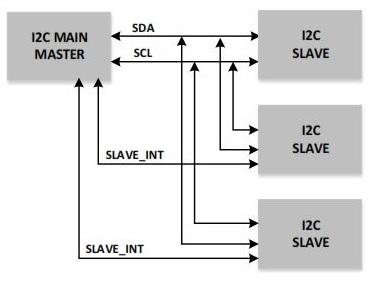
Initially, I2C was limited to 100 Kbps. However, the I2C bus now supports various speed categories, as shown below:
| Modes | Data rate | Bus Direction |
|---|---|---|
| Standard mode (Sm) | Up to 100 Kbps | Bidirectional |
| Fast mode (Fm) | Up to 400 Kbps | Bidirectional |
| Fast mode plus (Fm+) | Up to 1 Mbps | Bidirectional |
| High speed mode (Hs mode) | Up to 3.4 Mbps | Bidirectional |
| Ultra Fast mode (UFm) | Up to 5 Mbps | Unidirectional |
Key Features of I2C
- Includes electrical and timing specifications and associated bus protocol
- Two-wire interface using SDA (Serial Data) and SCL (Serial Clock) lines
- Unique start and stop conditions
- 7-bit slave device addressing (can be extended to 10 bits)
- Bi-directional data transfer
- Acknowledgement after each transferred byte
- No fixed transfer length
What is I3C?
The I3C specification was initially released in 2018 and updated in 2021. I3C stands for Improved Inter Integrated Circuit. It is a 2-wire digital interface similar to I2C, but with improvements over both I2C and SPI interfaces. The MIPI Alliance Inc. manages the I3C specifications.
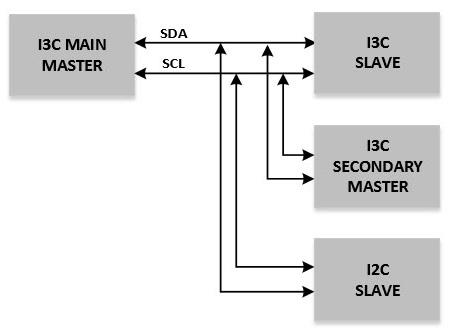
I3C provides a low-power, low-cost, and fast digital interface, supporting multi-master and multi-drop connections between host processors and peripheral devices like sensors.
Key Features of I3C
- 2-wire serial interface (SDA and SCL) with up to 12.5 MHz using push-pull configuration
- Legacy support for I2C devices on the same bus
- Dynamic addressing for I3C devices
- Supports static I2C addressing, I2C messaging, and I2C Single Data Rate (SDR) messaging
- Supports optional High Data Rate (HDR) messaging modes
- Supports multi-drop and multi-controller capabilities
- Supports In-Band Interrupt
- Supports Hot-Join
Difference between I2C and I3C
The following table provides difference between I2C and I3C as per various parameters.
| Parameters | I2C Interface | I3C Interface |
|---|---|---|
| In-Band Interrupt | Not supported | Supported |
| Effective Data Rate | Lower (Max. 3 Mbps) | Higher (Max. 33.3 Mbps) |
| Dynamic Addressing | Not supported | Supported |
| Energy Consumption | Higher | Lower |
| Hot Joining | Not supported | Supported |
| Advantages and disadvantages | I2C interface | I3C interface |
Summary
I2C and I3C are serial communication protocols used to connect multiple devices in embedded and electronic systems. I2C has been a reliable industry standard for decades, offering simple and cost effective communication. I3C, developed as its successor, delivers higher data transfer speeds, lower power consumption, improved bus efficiency and advanced device management features while maintaining backward compatibility with many I2C devices.
Advertisement


