
What is a BARITT Diode: Advantages and Disadvantages
Advertisement
A BARITT (Barrier Injection Transit Time) diode is a microwave semiconductor device used for signal generation and amplification at high frequencies. It offers low noise operation and simple construction. Advantages include low noise performance and reliability, while disadvantages include limited output power, lower efficiency, and restricted high-frequency capabilities.
What is a BARITT Diode?
Introduction: The BARITT (Barrier Injection Transit Time) diode shares a drift time characteristic similar to that of the IMPATT diode. However, it differs in its operation. Holes or electrons, which traverse the drift regions, are generated by injecting minority charge carriers from a forward biased junction. These diodes typically operate in the 4 to 8 GHz frequency range.
In a BARITT diode, the drift of minority carriers is due to “Thermionic emission” rather than the “Avalanche effect” seen in IMPATT diodes. This key difference results in BARITT diodes being less noisy compared to their IMPATT counterparts.
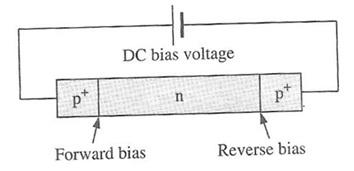
BARITT diode structure
BARITT diodes can be constructed with different structures, including p-n-p, p-n-i-p, p-n-metal, and metal-n-metal configurations. The figure above depicts a typical p+ - n - p+ structure.
Applications of BARITT Diode
BARITT diodes find application in several areas:
- Mixers
- Large signal Oscillators
- Small signal amplifiers
Benefits or Advantages of BARITT Diode
The following are the benefits and advantages of using a BARITT diode:
- Lower Noise: They generate less noise due to thermionic emissions compared to IMPATT diodes.
- Good Noise Figure: A BARITT amplifier made of silicon operating at C-band can achieve a noise figure of approximately 15 dB.
Drawbacks or Disadvantages of BARITT Diode
Here are the disadvantages associated with BARITT diodes:
- Narrower Bandwidth: They possess a relatively narrower bandwidth compared to other diode types.
- Lower Power Handling: BARITT diodes have a lower power handling capability, which decreases proportionally to the square of the frequency. The power output is typically limited to just a few milliwatts.
- Lower Efficiency: The efficiency of a BARITT diode decreases as the operating frequency increases. It’s around 5% for low frequencies.
Summary
A BARITT diode is a microwave device used in RF oscillators and amplifiers. Advantages include low noise operation, while disadvantages include lower power output and limited efficiency.
Advertisement


