
What is SIW: Substrate Integrated Waveguide Advantages and Disadvantages
Advertisement
Substrate Integrated Waveguide (SIW) is a planar transmission technology that combines conventional waveguide performance with printed circuit board fabrication techniques. Its advantages include low transmission loss, compact size, and easy integration, while its disadvantages include limited bandwidth, fabrication tolerances, and dielectric-related losses.
SIW waveguide Structure
As illustrated in the figure below, an SIW (Substrate Integrated Waveguide) structure consists of three layers: top and bottom ground planes with a dielectric layer sandwiched in between. A metallic via array (a series of holes) is placed between these two planes.
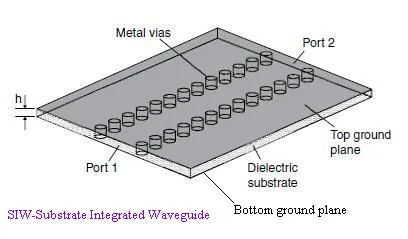
Microwave devices like filters, antenna arrays, power dividers, directional couplers, phase shifters, and transitions are often designed and manufactured using SIW structures because of the numerous advantages it offers.
Benefits or Advantages of SIW (Substrate Integrated Waveguide)
- Higher Power Handling: SIW structures can handle significantly more power compared to other planar transmission line technologies.
- Lower Radiation Losses: Radiation losses are minimized in SIW designs, leading to more efficient signal transmission.
- Lower Fabrication Cost: Manufacturing various RF components using SIW structures can be more cost-effective.
- High-Density Integration: SIW facilitates the high-density integration of discrete components directly onto the structure.
- Reduced Conductor Loss: The use of metal in SIW design helps to minimize conductor losses.
Drawbacks or Disadvantages of SIW (Substrate Integrated Waveguide)
- Leakage Losses: Leakage losses can be substantial and depend on the separation between the via holes on the top planes. Careful design is necessary to mitigate this.
- Dielectric Losses: The use of a dielectric material within the waveguide structure introduces dielectric losses compared to air-filled rectangular waveguides. These losses are frequency-dependent, so mmWave (millimeter wave) applications of SIW require careful consideration.
- Cutoff Frequency: Due to its waveguide structure, SIW exhibits a lower cutoff frequency. This can limit its performance at lower frequencies.
Summary
SIW technology offers an effective solution for compact microwave and millimeter wave circuits by combining waveguide efficiency with low cost PCB manufacturing. Its integration advantages support modern wireless communication, radar, and satellite systems despite fabrication and bandwidth limitations.