
What is LVDS : Advantages and Disadvantages
Advertisement
LVDS (Low Voltage Differential Signaling) is a high-speed data transmission technology that uses differential signaling with low voltage swings to reduce noise and power consumption. It is widely used in displays, communication systems, and embedded electronics. Advantages include high data rates and low EMI, while disadvantages include additional circuitry requirements.
Key Features of LVDS
LVDS stands for Low Voltage Differential Signaling. The primary standard for LVDS is defined in TIA/EIA-644. IEEE 1596.3 serves as an alternative standard.
It uses a current output of approximately 4 mA and is designed to drive a 100 Ohm load, aligning with its output impedance of around 100 Ohms.
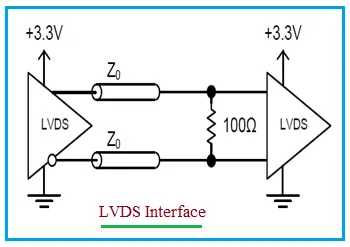
LVDS finds applications in backplane transceivers, clock distribution, and high-speed data transfer between boards or links on the same PCB. It can operate at data speeds up to 3.125 Gbps. LVDS signals may or may not require AC coupling after the 100 Ohm load.
Benefits or Advantages of LVDS
- Lower Power Consumption: It consumes less power compared to LVPECL and other signal types.
- Smaller Voltage Swing: It operates with a smaller voltage swing of about 350 mV.
- Noise Rejection: Offers good ground noise rejection and common-mode noise rejection.
- Signal Integrity: Supports longer line lengths and higher signaling rates due to maintaining good signal integrity.
- Low EMI Emissions: Has lower EMI emissions compared to TTL/CMOS interfaces.
- Easy Implementation: Relatively easy to implement in CMOS ICs.
- No External Biasing: LVDS output doesn’t require external biasing.
- Versatile Signal Support: Supports data, clock, and control signals.
Drawbacks or Disadvantages of LVDS
- No Multipoint Support: Unlike M-LVDS, RS485, and CAN interfaces, it doesn’t support multipoint applications.
- Reduced Jitter Performance: It has reduced jitter performance compared to PECL signal interfaces.
- Limited Data Rates: While it supports data rates up to 3.125 Gbps, other interfaces like HCSL, LVPECL, or CML are needed for higher data rates.
- Higher Cost: Generally more expensive.
- Twisted Cable Requirement: Typically requires twisted-pair cable.
Summary
LVDS enables high-speed, low-noise data communication in electronic systems. Advantages include low power consumption and excellent signal integrity, while disadvantages include increased design complexity and differential wiring requirements.