
Healthcare IoT: Pros & Cons of Indoor Tracking
Advertisement
Introduction : Hospitals are vast, chaotic and fast paced environments where every second counts. Yet, behind the scenes, healthcare facilities suffer from a massive logistical bottleneck i.e. keeping track of mobile medical equipment.
Industry data reveals that the average hospital nurse spends over 20 minutes per shift simply searching for misplaced items like infusion pumps, wheelchairs, blood pressure monitors and transport trolleys. Furthermore, equipment utilization rates often hover around a dismal 50% to 60%. Because staff cannot find the tools they need when they need them, hospitals frequently buy unnecessary backup equipment, or worse, accidentally throw valuable devices away in laundry or waste bins. In the U.S. alone, an average sized hospital can lose up to $2 million a year due to lost, stolen or underutilized equipment.
To cure this logistical issue, medical facilities are turning to Indoor Asset Tracking systems powered by Bluetooth Low Energy (BLE).
How BLE Indoor Asset Tracking Works
Global Positioning Systems (GPS) work great outdoors, but they cannot penetrate the thick concrete, lead lined walls and complex layouts of a hospital. Instead, indoor tracking relies on local wireless networks. A standard BLE asset tracking system works via a “Beacon and Gateway” architecture as described below.
- The Beacons (Tags): Small, battery powered BLE tags are attached to medical equipment (or even given to vulnerable patients). These tags emit a secure, unique radio signal at regular intervals (e.g. every five seconds).
- The Gateways (Receivers): Smart IoT gateways are installed strategically throughout the hospital’s corridors, wards and exit doors. These act as listeners, picking up the signals from the beacons.
- The Cloud Dashboard: The gateways relay the signal data to a centralized cloud platform. By measuring the signal strength, the system calculates the exact location of the asset and displays it on a digital floor plan accessible via a computer or smartphone app.
How BLE Beacons Save Time and Reduce Equipment Loss
1. Reclaiming Critical Nursing Time
When a patient goes into cardiac arrest, a nurse cannot afford to check five different rooms for a defibrillator. With a BLE tracking system, staff can simply open an app, search for the required device and instantly see that it is in “Ward 3, Room B.” By eliminating the need to physically hunt for equipment, nurses can redirect that saved time directly back to patient care.
2. Stopping Loss, Theft and Accidental Disposal
Because beacons transmit continuously, the system maintains a real time inventory of where everything is. Hospital IT can set up “geofences”; virtual boundaries around specific zones. If a $5,000 infusion pump is accidentally pushed into a waste disposal area, or if someone attempts to walk out the front door with a wheelchair, the system instantly triggers a digital alert to security or nursing staff.
3. Optimizing Equipment Utilization (or Buying Less)
Before IoT tracking, hospital administrators essentially guessed how much equipment they needed. Now, backend analytics provide hard data. If a hospital realizes that 30% of its blood pressure monitors sit unused in a storage closet all week, they know they do not need to order more. This data driven approach saves millions in unnecessary procurement costs.
4. Enhancing Patient Safety
The same tags used for equipment can be placed on wristbands for patients with dementia or severe cognitive impairments. If a vulnerable patient wanders out of their designated safe zone or approaches a stairwell, staff are immediately notified of their precise location, preventing accidents.
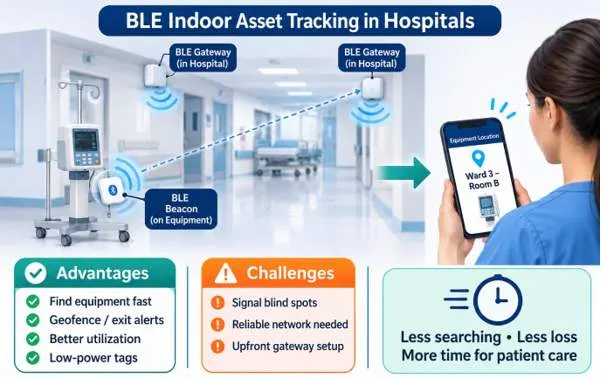
Advantages of BLE in Hospitals
- Ultra Low Power Consumption: Hospital maintenance teams do not have the time to change batteries on thousands of tags every month. BLE is incredibly energy efficient, allowing beacon tags to run for years on a single coin cell battery.
- High Accuracy and Scalability: BLE mesh networking allows hospitals to cover massive square footage reliably. Depending on gateway density, tracking accuracy can be narrowed down to a few meters (room level accuracy).
- Cost Effective Hardware: Compared to older RFID or Wi-Fi based tracking tags, BLE beacons are highly affordable, making it economically viable to track thousands of individual items.
Disadvantages or Challenges of BLE in Hospitals
- Radio Blind Spots: Hospitals are notoriously hostile environments for wireless signals. Thick walls, MRI machines, and dense metal equipment can block or bounce BLE signals. To overcome this, engineers must conduct meticulous site surveys to strategically deploy gateways so that no blind spots exist.
- Network Stability Requirements: In healthcare, a dropped network connection isn’t just an inconvenience; it can be catastrophic for patient care. Asset tracking systems must operate on secure, independent and “always on” networks to ensure data isn’t lost during hospital Wi-Fi outages.
- Initial Infrastructure Setup: While the tags are cheap, mapping out a multi story hospital, installing wired gateways and integrating the software into the hospital’s existing IT infrastructure requires a significant upfront investment of time and capital.
Summary
By giving a digital voice to physical medical equipment, Bluetooth LE asset tracking is transforming hospital operations. It transitions facilities from a state of reactive chaos to proactive management saving millions of dollars, reducing staff burnout and ultimately ensuring that life saving tools are always exactly where they need to be.
References & Further Reading
- Bluetooth SIG : Bluetooth Core Specification Version 6.3, May 5, 2026.
- Bluetooth SIG : Bluetooth Core Specification change history
- Bluetooth SIG : Bluetooth Technology Overview
Continue Learning Bluetooth Basic Concepts
- What are new features in Bluetooth 6.3 Version
- Bluetooth GATT Vs. ATT Vs. GAP : Key Comparison
- Bluetooth Service Vs. Characteristic Vs. Descriptor
- Bluetooth Central Vs. Peripheral : Key Differences
- Bluetooth pairing Vs. Bonding Phase
- Bluetooth Notifications Vs. Indications
- Bluetooth Channel Sounding Vs. RSSI
- Bluetooth Direction Finding Methods : AoA Vs. AoD
- Bluetooth HID Over GATT
- Bluetooth IRK Vs. LTK : Key Differences
- Bluetooth PHY : 1M Vs. 2M Vs. Coded Differences
- What is ATT MTU Size in Bluetooth
- Bluetooth Ranging : Phase Based Vs. RTT Based
- Bluetooth Error Codes Guide : Meanings, Causes & Fixes
- Bluetooth L2CAP and HCI : Key Differences
Continue Learning Bluetooth Technology
- Bluetooth Basics Tutorial
- Bluetooth Low Energy (BLE) Basics Tutorial
- Bluetooth Protocol Stack & Device State Diagram
- Bluetooth Physical Layer Modules
- Bluetooth MAC Layer Overview
- Bluetooth Channel Frequency List
- Bluetooth Network Security
- Bluetooth Low Energy (BLE) Connection Establishment Procedure
- Bluetooth Profiles: HFP, HSP, A2DP, AVRCP, PBAP & MAP
- Bluetooth Mesh Node Types & Protocol Stack Layer Functions
Compare Bluetooth With Other Technologies
- Bluetooth V5.0 Vs. V5.1 Vs. V5.2 Vs. V5.3
- Bluetooth Vs BLE : Key Differences
- Bluetooth Vs UWB Technology : Key Differences
- Bluetooth Vs Wi-Fi Vs UWB
- Comparison Between All Bluetooth Versions from 1.0 to 6.3
Explore Deep Insight Bluetooth Technology
- Bluetooth Error Recovery : ARQ, ACK, NAK
- Bluetooth Bit Stream Processing: HEC, CRC, FEC & More
- Bluetooth Routing: How Devices Know a Packet is for Them
- Bluetooth Flow Control: Understanding GO & STOP Bits
- Bluetooth Power Management: Sniff, Hold & Active Modes
- Bluetooth Packets Decoded: Structure, Types & Routing
- Decoding Bluetooth Packet Types: Control, ACL, SCO & eSCO