
What is HBT Transistor: Advantages and Disadvantages
Advertisement
A Heterojunction Bipolar Transistor (HBT) is a high-frequency transistor that uses different semiconductor materials to improve carrier transport and performance. It is widely employed in RF amplifiers, wireless communication systems, and microwave devices. Advantages include high gain and speed, while disadvantages include fabrication complexity and increased manufacturing costs.
Key Features of HBT Transistor
Introduction: Bipolar Junction Transistors (BJTs) can be manufactured using either homojunctions or heterojunctions.
- Homojunction transistors: These use the same materials joined together, like silicon to silicon.
- Heterojunction transistors: These use different materials joined together, for instance, germanium (Ge) to gallium arsenide (GaAs).
A homojunction transistor functions similarly to a traditional BJT.
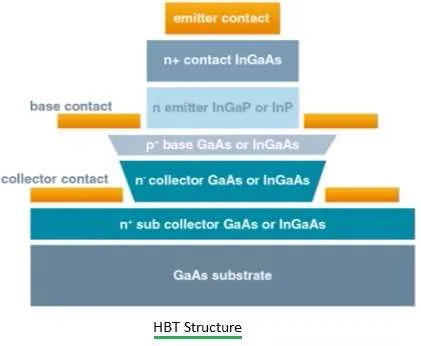 HBT Transistor
AlGaAs (Aluminum Gallium Arsenide) and GaAs (Gallium Arsenide) are commonly used materials in the construction of heterojunction BJTs. Figure 1 (above) shows a cross-section of an HBT, illustrating the different layers involved.
Advantages (Benefits) of HBT Transistors
- Low Base Resistance and Forward Transit Time: HBTs offer lower base resistance and reduced forward transit time due to significantly higher base doping.
- Higher Cut-off Frequency: Consequent to the points above, HBTs can achieve a higher cut-off frequency, which is crucial for high-speed applications.
- Low Collector-to-Substrate Capacitance: The use of a semi-insulating GaAs substrate results in very low collector-to-substrate capacitance, improving performance.
- Higher Efficiency: HBT devices can be completely turned off with small variations in base voltage, leading to higher efficiency.
- Wideband Impedance Matching: HBTs are capable of wideband impedance matching, crucial for RF and microwave circuits.
- Cost-Effective and Efficient: They offer a compelling combination of lower cost and higher efficiency in some applications.
Disadvantages (Drawbacks) of HBT Transistors
- Material-Dependent Drawbacks: The specific disadvantages of HBTs often depend on the materials used in their construction. For example:
- InP HBTs: Indium Phosphide (InP) HBTs can be brittle and require expensive substrates.
- Immature Technology: InP HBT technology is less mature compared to GaAs HBT.
- Low Breakdown Voltage: Silicon (Si) and Silicon Germanium (SiGe) based HBTs tend to have lower breakdown voltages, which limits their use in high-voltage applications.
Summary
HBT transistors deliver high-speed RF performance for communication systems. Advantages include superior frequency response and efficiency, while disadvantages include costly fabrication processes.
Continue Learning Transistor
- CB CE CC - Transistor Configurations
- Transistor Types & Applications : BJT FET MOSFET UJT
- Transistor as a Switch
- PMOS Vs. NMOS Transistors : Key Differences
- PNP vs NPN Transistors : Key Differences
- Transistor : Key Advantages & Disadvantages
- Transistor Alpha & Beta
- RF Transistor Selection Guide & Manufacturers
- E-Mode Vs. D-MOde in GaN Transistor
- Darlington Pair Transistor : Key Advantages & Disadvantages