
Half Duplex vs. Full Duplex Radio: Key Differences
By RF Wireless Expert Team
Advertisement
This page compares half duplex radio and full duplex radio, outlining the key differences in their principles of operation.
Introduction:
Mobile devices, like phones, tablets, and radio handsets, communicate with cellular networks using electromagnetic (EM) frequencies, often referred to as radio frequencies. These frequencies are a critical resource for communication. To efficiently manage these resources, techniques like Time Division Multiple Access (TDMA) and Code Division Multiple Access (CDMA) are used to share them among multiple devices. These devices find applications in both commercial and military sectors.
Half Duplex Radio
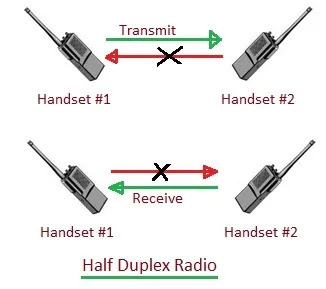 Figure 1: Half duplex radio
- As depicted in Figure 1, half duplex radio systems, such as walkie-talkies, communicate one at a time.
- They cannot transmit and receive simultaneously.
- When handset #1 is transmitting, handset #2 can only receive, and vice versa.
- This type of radio system is known as a half duplex radio system.
Full Duplex Radio
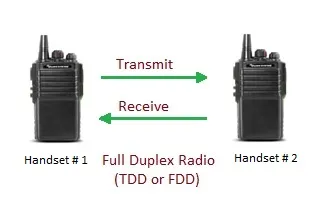 Figure 2: Full duplex radio
- Figure 2 illustrates a full duplex radio system.
- Handsets can communicate with each other simultaneously.
- This means they can transmit and receive data at the same time.
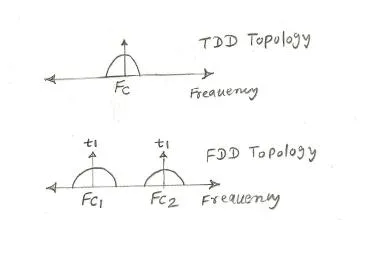
- This simultaneous communication is made possible through Time Division Duplexing (TDD) and Frequency Division Duplexing (FDD).
- In TDD, handsets communicate simultaneously using the same frequency channel but at different time slots. In FDD, they communicate simultaneously using two different frequency channels at the same time.
- This type of radio system is known as a full duplex radio system.
Continue Learning Digital Mobile Radio (DMR) & Professional Mobile Radio
- DMR Radio Basics Tutorial
- DMR Tier 1 vs Tier 2 vs Tier 3: Understanding the Differences
- DMR vs dPMR Comparison
- NXDN vs DMR Comparison
- Digital Mobile Radio (DMR) Interview Questions and Answers
Explore More Radio Technologies & Standards
- TETRA Radio System Tutorial
- LITRA (LTE Integrated Trunked Radio) Explained
- OpenSky Radio System Basics
- Public Safety Radio Frequencies (USA)
- Two-Way Radio Headsets Basics
- Understanding CBRS (Citizens Broadband Radio Service)
- Commercial and Concept Radio Systems
- PMR446 Radio Frequency Channels
Explore Broadcasting, AM/FM & Ham Radio
- Regular FM Radio Broadcasting Basics
- HD Radio Technology & AM/FM Spectrum Explained
- Digital Radio Mondiale (DRM)
- IBOC Basics (In-Band On-Channel Digital Radio)
- Radio Broadcasting: Advantages & Disadvantages
- Analog vs Digital Radio
- Amateur Radio Bands and Frequencies
- Ham Radio: Advantages & Disadvantages
- Internet Radio: Advantages & Disadvantages