
What is Foster Seeley Discriminator : Advantages and Disadvantages
Advertisement
The Foster Seeley discriminator is an FM demodulation circuit used to convert frequency variations into corresponding voltage changes. It is widely used in FM radio receivers and communication systems. Advantages include good linearity and sensitivity, while disadvantages include susceptibility to amplitude noise and the need for amplitude limiting stages.
Different types of modulation and demodulation techniques exist, including those for amplitude, phase, and frequency. Several techniques are used as frequency demodulators or detectors. These include following.
- Quadrature detector
- Slope detector
- PLL detector
- Foster Seeley discriminator
- Ratio detector
- DSP-based FM demodulator
Foster Seeley Discriminator Circuit & its Working
The Foster Seeley Discriminator is a type of FM detector used to demodulate frequency modulated signals. It’s also utilized as an AFC (Automatic Frequency Control) component in receivers such as super-heterodyne receivers.
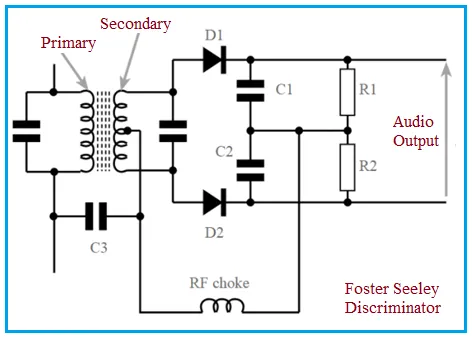
The diagram above shows the circuit of a Foster Seeley Discriminator. The circuit resembles a full wave bridge rectifier with a center tapped transformer.
It employs a tuned version of a transformer to convert frequency variations into amplitude variations. As shown, the transformer is tuned to the desired carrier frequency and connected to rectifier diodes. RF choke, C1, and C2 components block the RF signal from appearing at the output.
Advantages of Foster Seeley Discriminator
- It provides good performance.
- It offers a fair amount of linearity.
- It is simple to implement using readily available components.
- It delivers a higher output compared to a ratio detector.
- It provides an output with lower distortion compared to a ratio detector.
Disadvantages of Foster Seeley Discriminator
- It is difficult to integrate this circuit into an IC (Integrated Circuit).
- It is more expensive due to the higher cost of the required transformer.
- It has a narrower bandwidth compared to a ratio detector.
- A limiter is required along with the Foster-Seeley Discriminator because it is sensitive to both frequency and amplitude variations.
Summary
Foster-Seeley discriminators are commonly used for FM signal demodulation. Advantages include accurate frequency detection and good sensitivity, while disadvantages include noise sensitivity and additional circuit requirements.
Continue Learning Modulation Types
- AM Vs. FM Vs. PM : Difference between Analog Modulation Techniques
- ASK Vs. FSK Vs. PSK : Difference between Digital Modulation Techniques
- PAM Vs. PWM Vs. PPM : Difference between Pulse Modulation Techniques
- BPSK Vs. QPSK : Key Differences
- 16-QAM Vs. 64-QAM Vs. 256-QAM : Key Differences
- 512-QAM Vs. 1024-QAM Vs. 2048-QAM Vs. 4096-QAM
- 4096QAM Modulation Used in Wi-Fi 7
- MSK Vs. GMSK : Modulation Technique used in GSM
- LORa Modulation Used in LoRaWAN
- 10% ASK & 100% ASK Modulation used in NFC
- OOK Vs. VPPM Vs. CSK : Visible Light Communication (VLC) Modulation Techniques
- QPSK Vs. OQPSK Vs. PI/4 QPSK
- PAM4 Modulation Used in Gigabit Ethernet
- CCK Vs. DSSS Vs. OFDM Used in WLAN (Wi-Fi) Standards