
Flash LiDAR vs. Scanning LiDAR: Key Differences & Trade offs
Advertisement
Introduction : There are various applications of LiDAR, one such application is to create 3D map. To fulfill mapping, LiDAR illuminates its surroundings. The two primary methods are scanning LiDAR and Flash LiDAR. Scanning LiDAR paints scene point by point. Flash LiDAR captures an entire scene in a single burst.
Scanning LiDAR
This LiDAR type focuses all of its laser energy into single, narrow beam and moves that beam across the field of view. Let us understand how it works.
- The system fires a pulse, measures the distance to one specific point and then uses a steering mechanism such as motor or MEMS mirror or optical phased arrays to move to the next point. It repeats this thousands of times per second to “build” a 3D point cloud.
Pros of scanning LiDAR
Following are benefits or advantages of scanning LiDAR type.
- In this liDAR type, laser power is concentrated into one tiny spot, which allows for detection of distant objects as far as 200 to 300 meters.
- It offers high resolution of maps by increasing number of points scanned.
- It is easier to filter out solar noise when you are only looking at one tiny spot at a time.
Cons of scanning LiDAR
Following are drawbacks or disadvantages of scanning LiDAR type.
- It requires precise timing between the laser and the steering hardware.
- Since it takes time to finish a “scan,” fast moving objects might appear distorted.
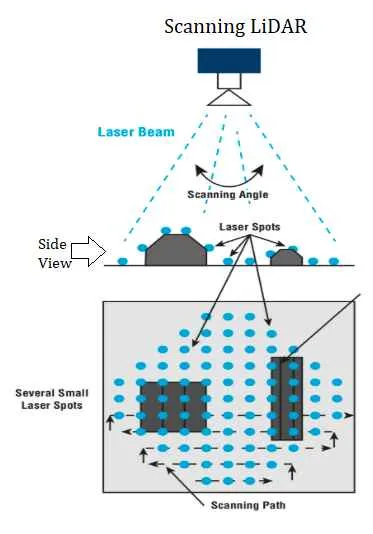 Image courtesy : IEEE Sensors Council
Flash LiDAR
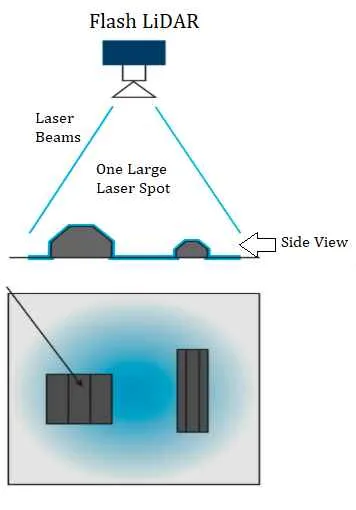
This LiDAR type operates like a traditional digital camera equipped with a flash. Instead of a moving beam, it floods the entire scene with a wide “flash” of infrared light. Let us understand how it works. The flash LiDAR is based on solid state technology and does not use any motors, mirrors or steering components.
- The system uses a wide angle lens to spread the laser light across the entire field of view at once.
- The reflection is captured by a 2D array of sensors similar to a camera’s pixels.
- Every “pixel” on this sensor measures its own Time of Flight (ToF) simultaneously.
- Based on above, entire 3D image can be developed.
Pros of Flash LiDAR
Following are benefits or advantages of flash LiDAR type.
- It offers high frame rate. Hence it captures the entire 3D scene instantly, making it excellent for tracking fast-moving objects without distortion.
- With zero moving parts, it is highly resistant to vibration and mechanical failure.
- Simplifies the system design by removing the need for beam steering synchronization.
Cons of Flash LiDAR
Following are drawbacks or disadvantages of flash LiDAR type.
- Spreading the light thin means it cannot travel very far before the signal becomes too weak to detect. Hence it’s range is limited and it is usually about less than 50 meters.
- The wide angle receiver “sees” a lot of sunlight, which can easily drown out the laser signal in outdoor environments.
Comparison between flash and scanning LiDAR
| Feature | Scanning LiDAR | Flash LiDAR |
|---|---|---|
| Illumination | Narrow, moving beam (i.e. point to point) | Wide, single burst (Full frame) |
| Capture time | Slow | Instant |
| Detection range | Long , up to 300 meters | Short, typically < 50 meters |
| Moving parts | Yes, motors or MEMS mirrors | None |
| Motion distortion | Possible, rolling shutter effect | None, immune to motion blur |
| Complexity | High, requires beam steering | Low, simplified optics |
| Cost | Higher | Lower |
| Best use case | Autonomous highway driving, drones | Indoor robotics, gesture control, AR |
Summary
The choice between the LiDAR type depends on range vs. speed requirements. If you are designing a vehicle that needs to see a stalled car on a highway 200 meters away, Scanning LiDAR is the necessary choice because it concentrates its energy to reach that distance. However, if you are building a small indoor robot or a vacuum that needs to navigate a room in real time without bulky moving parts, Flash LiDAR provides a faster, more durable and cost effective solution.
Continue Learning LiDAR Fundamentals & Types
- LiDAR Advantages and Disadvantages
- LiDAR as Target Detection and 3D Mapping/Imaging
- LiDAR 905nm vs 1550nm Differences
- Mechanical Scanning vs Solid-State LiDAR Differences
- Single-Shot vs Multi-Shot LiDAR Differences
- dToF vs iToF LiDAR Differences
- Legacy vs Modern LiDAR Detectors Differences
Explore Technology Comparisons (LiDAR vs. Radar vs. Cameras)
- LiDAR vs Radar: Understanding the Differences
- LiDAR vs LADAR Differences
- LiDAR vs Time of Flight (ToF)
- Radar vs LiDAR vs UWB vs Camera Comparison
Explore More LiDAR Engineering Calculators
- LiDAR Distance Calculator and ToF Formula
- FMCW LiDAR Distance Calculator and Formula
- iToF LiDAR Distance Calculator and Formula
- LiDAR Received Power Calculator and Formula
- LiDAR Point Density Calculator and Formula
- 3D LiDAR Point Coordinate Calculator and Formula
- Bathymetric LiDAR Depth Calculator and Formula