
What is Edge Emitting LED : Structure, Working, Advantages and Disadvantages
Advertisement
An edge emitting LED is a semiconductor light source that emits light from the edge of its active region rather than the surface. It is widely used in optical communication and sensing systems. Advantages include higher optical coupling efficiency and directional output, while disadvantages include complex fabrication and alignment requirements.
Edge Emitting LED Structure and Working Operation
-
Edge-emitting LEDs are commonly used in optical fiber communication systems. Here, collimated light from the LED needs to be efficiently coupled into the fiber.
-
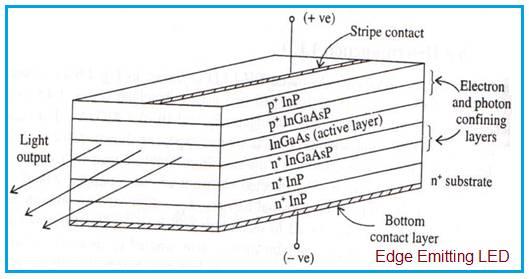
Figure 1 shows the multilayer structure of an InP-based edge-emitting LED. These are often used for long-wavelength optical communication, roughly between 1.33 and 1.55 µm.
-
Modern epitaxial growth techniques, like MBE (Molecular Beam Epitaxy) and MOCVD (Metal-Organic Chemical Vapor Deposition), are used to create these complex LED structures.
-
The central active layer is made of InGaAs, which has a narrow bandgap. It’s surrounded by wide bandgap layers, such as p+ InGaAsP and n+ InP cladding layers.
-
These cladding layers confine injected electrons and holes to the middle layer. They also help the emitted photons travel along the LED axis due to their optical properties.
-
As a result, light is emitted from the edge of the LED, hence the name “edge-emitting LED.”
Advantages of Edge Emitting LEDs
Here are the benefits of using edge-emitting LEDs:
- Superior Beam Collimation: Provides greater coupling efficiency with fiber optic cables compared to surface-emitting LEDs.
- Higher Efficiency: Offers good efficiency with low to high radiance. Suitable for high-brightness LED lighting applications.
- Reduced Power Loss: Radiates less power to the air compared to surface-emitting LEDs due to reduced reabsorption and interfacial recombination.
- Better Modulation Bandwidth: Exhibits a better modulation bandwidth and a more directional emission pattern.
- Increased Coupled Power: Delivers 5-6 times more coupled power into the NA (Numerical Aperture) of step/graded index fibers, thanks to small beam divergence.
- High Data Rates: Supports higher data rates (> 20 Mbps) compared to surface-emitting LEDs.
Disadvantages of Edge Emitting LEDs
The drawbacks of using edge-emitting LEDs include:
- Complex Structure: The design and fabrication are intricate.
- Difficult Heat Sink Design: Designing an effective heat sink can be challenging.
- Higher Cost: They are more expensive compared to other LED types.
- Installation Issues: Mechanical mounting and installation can be problematic.
Summary
Edge emitting LEDs provide directional light output for optical communication applications. Advantages include improved coupling efficiency, while disadvantages include manufacturing complexity and higher costs.
Advertisement


