BLE Channel Hopping Benefits
Explore BLE Channel hopping and its benefits and usage in Bluetooth Low Energy standard specification.
Advertisement
Explore articles, explainers, and practical references focused on Bluetooth within Terminology.
Articles
91
Showing
51-75
Pages
3/4
More in Terminology
Jump across related topic clusters without losing your place.
Advertisement
Article Index
Showing 51-75 of 91 articles in this archive.
Explore BLE Channel hopping and its benefits and usage in Bluetooth Low Energy standard specification.
Compare coded PHY vs 1M PHY vs 2M PHY modes used in Bluetooth Low Energy (BLE) and explore difference between them.
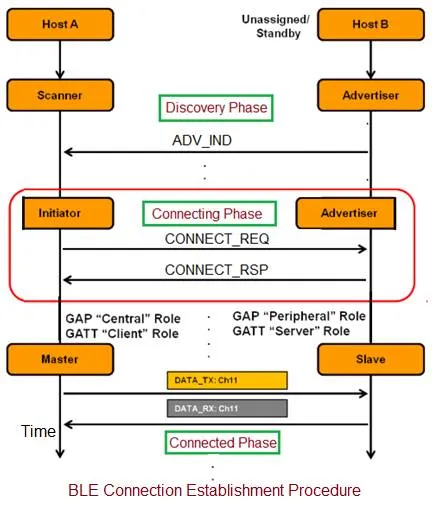
Understand the BLE connection process: discovery, connecting (CONNECT_REQ), and connected phases. Learn about master/slave roles, connection intervals, and key BLE states.

Explore the BLE protocol stack and system architecture, detailing each layer's functions from the physical layer to the application layer. Understand how BLE devices communicate and exchange data.
Explore BLE security keys viz. TK, STK, LTK, CSRK and IRK and key differences between them as per BLE specification.
Explore BLE Link Layer States viz. advertising, scanning and connected. Learn key functions and activities of these Bluetooth Low Energy states.
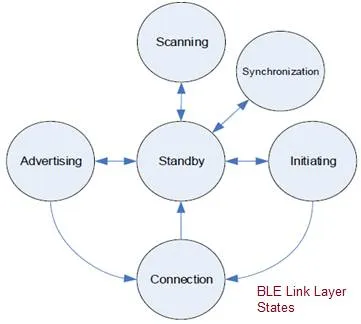
Explore the different states of BLE (Bluetooth Low Energy) devices, including Standby, Advertising, Scanning, Initiating, Connection, and Synchronization.
Explore the differences between Bluetooth 5 and 5.1, focusing on new features like direction finding (AoA/AoD) and improvements in GATT caching.
Explore the evolution of Bluetooth technology from version 5.0 to 5.3, highlighting the key differences in speed, range, audio quality, and power efficiency for various applications.
Explore the key differences between Bluetooth 5.0 and 4.2, including speed, range, power consumption, and suitability for IoT devices. A detailed comparison of the latest Bluetooth iterations.
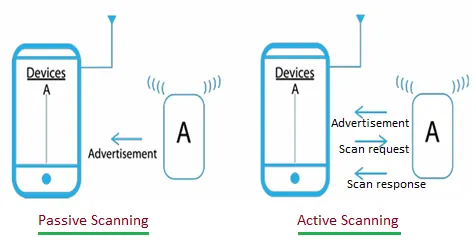
Compare Bluetooth active vs passive scanning and explore difference between active and passive scanning types.
Learn Bluetooth address types and subtypes viz. public and random (static and private sub-type) including their usage.
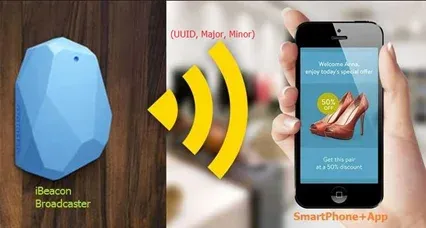
Explore 5 key advantages and disadvantages of Bluetooth beacon including its working and application as indoor positioning method.
Compare BR vs EDR PHY modes used in Bluetooth Classic and explore difference between them.
Explore the differences between Bluetooth Classic and Bluetooth Smart (BLE) specifications, applications, and performance metrics like range, throughput, and power consumption.
Explore the layers of the Bluetooth Mesh protocol stack, including model, access, transport, network, bearer, and BLE core specifications.
Explore the distinctions between Bluetooth Mesh and Zigbee Mesh technologies, comparing specifications, frequencies, range, data rates, and applications.

Explore various Bluetooth profiles like HFP, HSP, A2DP, AVRCP, PBAP, and MAP, detailing their functions, key features, and use cases for seamless device communication.
Learn about Bluetooth sniffers, including how they work and which vendors offer them. Capture and analyze Bluetooth packets.
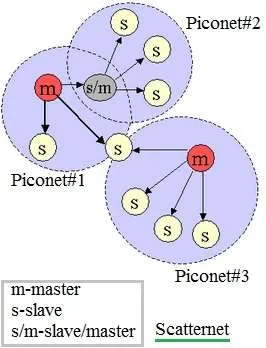
Explore Bluetooth technology, its advantages like wireless convenience and disadvantages like limited range, plus its history, versions, and key applications.
Explore the evolution of Bluetooth technology through a comparison of versions v1.2, v2.0, v2.1, v3.0, v4.0, and v4.1, including speeds and compatibility.
Explore the distinctions between Bluetooth and Bluetooth Low Energy (BLE), highlighting their applications, power consumption, and suitability for various wireless communication needs.
Explore the key differences between Bluetooth and Zigbee wireless technologies, including specifications, topology, data rates, and typical applications.

Explore the Cicret Bracelet, a wearable device projecting smartphone interfaces onto your skin. Learn about its components, functionality, and potential applications.
Compare Classic Bluetooth vs BLE and explore difference between Classic Bluetooth and BLE highlighting their range, frequency, data rate, channels, power consumption and connection time.
Advertisement