
TTP Protocol: Key Benefits, Features & Limitations
Advertisement
Introduction : TTP (Time Triggered Protocol) enables deterministic and fault tolerant communication for safety critical vehicle systems.
What is TTP Protocol?
In the high stakes world of safety critical automotive systems, where a millisecond can make all the difference, the Time Triggered Protocol (TTP) stands out as a communication standard built on a foundation of predictability and reliability. Unlike event triggered protocols like CAN, which react to events as they occur, TTP orchestrates communication based on a pre-defined, globally synchronized schedule.
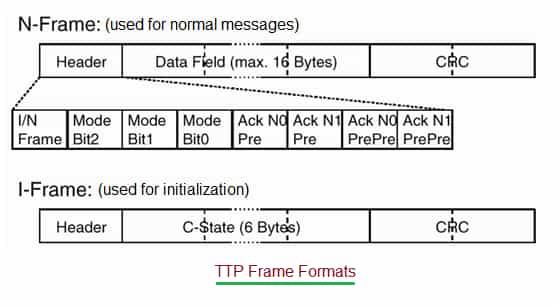
TTP enables time triggered communication through strict Time Division Multiple Access (TDMA) scheme.
Advantages of TTP
Following are some of the benefits of TTP.
- Determinism and predictability : It guarantees when messages will be sent and received.
- TTP was designed with fault tolerance as primary goal. It supports replicated channels and nodes to handle failures. Protocol includes mechanism known as “bus guardian” which can prevent a faulty node from disrupting entire network.
- TTP systems are temporally composable. This means behavior of individual subsystems can be analyzed and verified independently.
- It simplifies error detection as message arrival times are known in advance.
- By eliminating the need for bus arbitration, TTP can achieve higher effective data rates compared to older protocols like CAN. The protocol’s message overhead is also minimal.
- TTP provides a membership service that keeps all correct nodes informed about the status and consistency of data transmission from other nodes.
Disadvantages of TTP
Following are some of the limitations of TTP.
- The static nature of the TDMA schedule makes TTP less flexible than event-triggered protocols.
- While efficient for periodic data, the pre-allocated slots can be wasteful if a node only needs to transmit data sporadically.
- The upfront design and scheduling of a time triggered system can be complex.
- The specialized hardware controllers required for TTP could be more expensive than those for more widespread protocols like CAN.
Conclusion: In summary, it offers benefits like guaranteed latency, system scheduling and redundancy but also limitations such as higher cost, design rigidity and complexity in network configuration.
Tags
Advertisement


