
What is J1850 Protocol Frame : Advantages and disadvantages
Advertisement
J1850 is an automotive communication protocol developed for vehicle diagnostics and electronic control unit (ECU) communication. It was widely used in North American vehicles before the adoption of CAN bus systems. Advantages include reliable vehicle communication and diagnostic support, while disadvantages include limited speed and declining industry adoption.
Introduction : The J1850 protocol delivers a legacy standard for vehicle diagnostics (including PWM and VPW variants) and offers simplicity and broad compatibility with older vehicles.
J1850 Frame and its fields
It was primarily used in vehicles from the 1990s and early 2000s, J1850 was a key protocol for on board diagnostics (OBD-II) and communication between various electronic control units (ECUs) before the widespread adoption of the Controller Area Network (CAN) bus.
The frame of J1850 contains a Start of Frame, a Header, a Data payload, a Cyclic Redundancy Check (CRC) and an End of Frame.
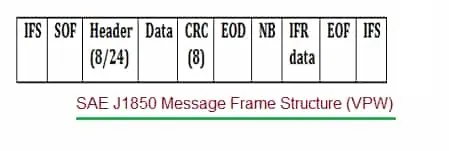
It was developed by the Society of Automotive Engineers (SAE). It facilitated the exchange of data for functions like engine and transmission control, emissions monitoring and diagnostics.
PWM and VPW
-
J1850 PWM (Pulse Width Modulation): This version was predominantly used by Ford. It operated at a data rate of 41.6 kbps and utilized a two wire differential signaling approach.
-
J1850 VPW (Variable Pulse Width): General Motors, on the other hand, favored the J1850 VPW standard. This version had a slower data rate of 10.4 kbps and employed a single wire communication bus.
Advantages of J1850
Following are some of the benefits of J1850.
- Both single wire VPW and dual wire PWM are relatively low cost networking solutions.
- As component of OBD-II, J1850 provides standardized way for external device to communicate with ECU of vehicle compared to other proprietary approaches.
- It simplifies in-vehicle communication between various modules.
- J1850 is a masterless protocol, meaning any ECU can initiate communication. Moreover it implements CSMA/CR which handles issues pertaining to simultaneous transmission by multiple ECUs.
- It uses CRC (Cyclic Redundancy Check) which handles error detection and hence ensures integrity and accuracy of transmitted data.
Disadvantages of J1850
Following are some of the limitations of J1850.
- It supports lower data rates i.e. 10.4 kbps for VPW and 41.6 kbps for PWM. Hence it is significantly slower than modern protocols.
- As it has limited scalability, it is not suitable for rapidly growing number of electronic systems in vehicles.
- J1850 is being phased out due to availability of more advanced protocols such as CAN and its variants. These latest protocols offer higher speeds which is up to 1 Mbps and beyond.
- Both PWM and VPM versions are incompatible. This requires to be checked while using specific tools for diagnosis of ECUs.
Conclusion:
J1850 is a legacy automotive networking protocol for ECU communication and diagnostics. Advantages include reliability and simplicity, while disadvantages include lower data rates and obsolescence.
Analysis of Other Automotive Protocol Frames
- CAN Protocol Frame Analysis
- CAN-FD Frame Analysis
- CANopen Frame Analysis
- LIN Frame Analysis
- DoIP Frame Analysis
- FlexRay Frame Analysis
- ISO-TP Frame Analysis
- J1850 Frame Analysis
- K-line Frame Analysis
- MOST Frame Analysis
- TTP Frame Analysis
- UDS Frame Analysis
- Automotive Ethernet Frame Analysis
- SENT Frame Analysis
- SENT Protocol : Key Advantages & Disadvantages